
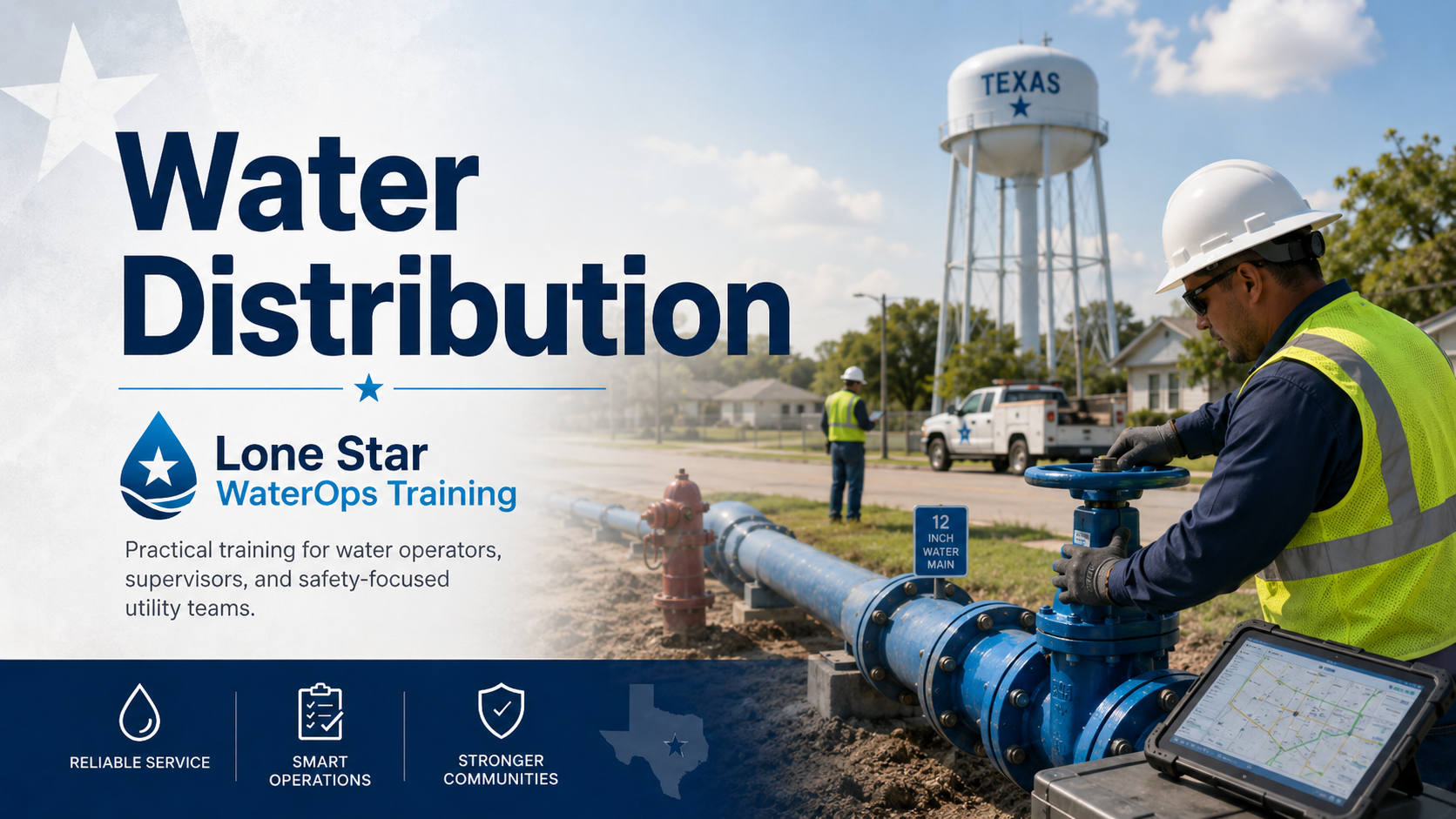
Water Distribution - C.4 | September 29 - October 1st, 2027 | 20 hr
This course focuses on moving safe drinking water from the plant or well site to the customer. Topics include water mains, valves, hydrants, storage tanks, pressure zones, pumps, flushing, line repairs, cross-connection concerns, disinfectant residuals, and distribution system water quality. It is a key course for both plant and field operators. 20-Hr Course
Prerequisites
There are no prerequisites for this course. Basic Water Works is recommended prior to taking this course.
Course Completion Requirements
Participants must provide information for all required fields, including their U.S. citizenship/permanent resident status, and meet all attendance and course completion requirements. If this information is not provided, the participant may be considered incomplete and may not receive a certificate of completion.
Technology Requirements & Online Course Participation Notice
Lone Star WaterOps Training | Live-Online Instructor-Led Courses
All live-online courses offered by Lone Star WaterOps Training are conducted through Google Meet and require students to participate in real-time instruction with a qualified instructor. These courses are not self-paced or prerecorded.
To ensure successful participation, students must meet the following technology and attendance requirements.
Required Technology and Equipment
Computer: A desktop or laptop computer capable of running Google Meet and accessing online course materials. A computer is strongly recommended over a smartphone or tablet, particularly for courses involving calculations, diagrams, or written assessments.
Internet Connection: A reliable, high-speed internet connection capable of supporting continuous live video conferencing, audio, and screen sharing.
Web Browser: An updated version of Google Chrome, Microsoft Edge, Safari, or another browser supported by Google Meet.
Camera: A functioning webcam, either built into the computer or connected externally, for identity verification and participation checks.
Microphone and Speakers: A working microphone and speakers or a headset to communicate with the instructor and other participants.
Google Meet Access: Students must be able to access Google Meet using the meeting link provided before the course. A Google account may be needed for certain participation features or access settings.
Course Materials: Students must be able to open electronic documents, view presentations, and access any online quizzes, evaluations, or supplemental resources.
Calculator: A basic scientific calculator is recommended for courses involving water treatment and distribution calculations.
Attendance and Participation Requirements
Students must join the live Google Meet session at the scheduled start time and remain connected during required instructional periods.
Students must provide their full legal name during registration and use an identifiable display name during the course.
Students must have their camera available for identity verification and whenever directed by the instructor.
Active participation is required through instructor-led discussions, questions, scenario-based activities, video-supported demonstrations, and knowledge checks.
Students must attend from a quiet, safe environment that allows them to focus on instruction without unnecessary interruptions.
Students must not attend class while driving, operating equipment, or performing other activities that interfere with safe and effective participation.
Students are responsible for completing all required assessments, course evaluations, and participation activities.
Technical Difficulties and Connectivity Interruptions
Students are responsible for testing their equipment and internet connection before the course begins.
If a technical issue occurs, the student must notify the instructor as soon as possible. Significant interruptions may result in missed instructional time that must be addressed before course completion or training credit can be awarded.
Simply logging into Google Meet does not establish attendance or successful course completion. Attendance is based on verified participation and documented instructional time.
Important Notice Regarding Training Credit
Successful course completion requires verified attendance, active participation, and completion of required assessments and instructional activities.
Training hours toward TCEQ occupational licensing are subject to applicable TCEQ requirements and course/provider approval. Enrollment alone does not guarantee licensing credit.
By registering for a live-online course, students acknowledge that they have reviewed these requirements and are responsible for ensuring their technology and learning environment support successful participation.
Recommended Prior Training Courses or Knowledge
Prior water utility experience is helpful but not required. This course is recommended for entry-level water operators, utility employees, and individuals preparing to begin the TCEQ water operator licensing pathway.
Upon Successful Completion, Participants Will Be Able To
Explain the basic responsibilities of a public water system operator.
Identify major components of water treatment and distribution systems.
Describe basic water quality, disinfection, safety, and regulatory concepts.
Recognize common operational terms, equipment, and procedures used in drinking water operations.
Apply basic operator knowledge to support safe and compliant utility operations.