
Register Today *
Invest in Yourself. *
Advance Your Career. *
Register Today * Invest in Yourself. * Advance Your Career. *
Online Course Technology Requirements
All courses are delivered entirely online through Google Meet. Participants must have access to a reliable computer or laptop, a stable high-speed internet connection, a working microphone, and a functioning webcam. Participants are responsible for confirming that their equipment and internet connection are working properly before the course begins. Access to Google Meet is required to attend, participate in course activities, verify attendance, and meet all course-completion requirements.
TCEQ Wastewater CORE
TCEQ Wastewater CORE
Filters
Filters
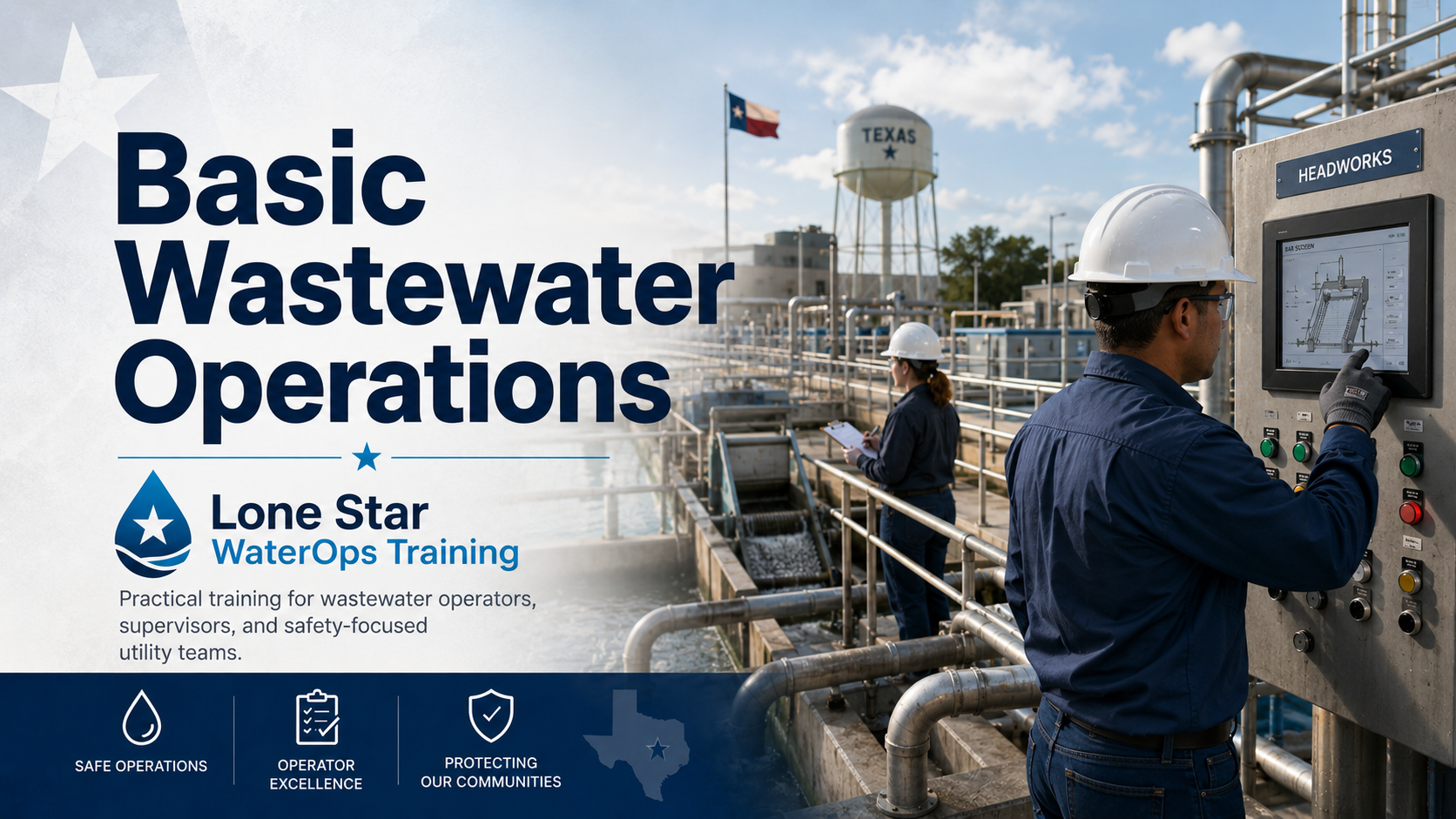
This introductory course provides a foundational understanding of wastewater collection and treatment systems. Instruction covers the water cycle, wastewater sources and characteristics, domestic wastewater pretreatment, preliminary treatment, sedimentation, biological treatment, activated sludge, fixed-film processes, stabilization ponds, sludge digestion, disinfection, system safety, and basic operational calculations. The course also addresses the responsibilities of wastewater operators, applicable laws and regulations, pollution prevention, and the protection of receiving waters, public health, and the environment. 20-hour course
Prerequisites
There are no prerequisites for this course.
Course Completion Requirements
Participants must provide information for all required fields, including their U.S. citizenship/permanent resident status, and meet all attendance and course completion requirements. If this information is not provided, the participant may be considered incomplete and may not receive a certificate of completion.
Participant Must Provide
Simple calculator with square root function.
Photo identification on the first day of class. See the “Policy” page of the website for approved forms of identification and additional guidelines.
Course materials, notebook, and writing utensils as directed by the instructor.
Attendance Requirements
Class attendance is an essential part of the education process. Participants are expected to attend all class sessions, activities, discussions, and required exercises. This course requires participants to attend a minimum of 100% of the class hours as a component of successful course completion. During the course, the instructor will review any additional attendance or participation requirements.
Recommended Prior Training Courses or Knowledge
Prior wastewater experience is helpful but not required. This course is recommended for entry-level wastewater operators, utility employees, and individuals beginning the TCEQ wastewater operator licensing pathway.
Upon Successful Completion, Participants Will Be Able To
Describe the basic responsibilities of a wastewater operator.
Identify major components of wastewater collection and treatment systems.
Explain basic wastewater characteristics, treatment objectives, safety concerns, and regulatory concepts.
Recognize common wastewater terms, equipment, and operational procedures.
Apply basic wastewater operations knowledge to support safe and compliant utility performance.
This introductory course provides a foundational understanding of wastewater collection and treatment systems. Instruction covers the water cycle, wastewater sources and characteristics, domestic wastewater pretreatment, preliminary treatment, sedimentation, biological treatment, activated sludge, fixed-film processes, stabilization ponds, sludge digestion, disinfection, system safety, and basic operational calculations. The course also addresses the responsibilities of wastewater operators, applicable laws and regulations, pollution prevention, and the protection of receiving waters, public health, and the environment. 20-hour course
Prerequisites
There are no prerequisites for this course.
Course Completion Requirements
Participants must provide information for all required fields, including their U.S. citizenship/permanent resident status, and meet all attendance and course completion requirements. If this information is not provided, the participant may be considered incomplete and may not receive a certificate of completion.
Participant Must Provide
Simple calculator with square root function.
Photo identification on the first day of class. See the “Policy” page of the website for approved forms of identification and additional guidelines.
Course materials, notebook, and writing utensils as directed by the instructor.
Attendance Requirements
Class attendance is an essential part of the education process. Participants are expected to attend all class sessions, activities, discussions, and required exercises. This course requires participants to attend a minimum of 100% of the class hours as a component of successful course completion. During the course, the instructor will review any additional attendance or participation requirements.
Recommended Prior Training Courses or Knowledge
Prior wastewater experience is helpful but not required. This course is recommended for entry-level wastewater operators, utility employees, and individuals beginning the TCEQ wastewater operator licensing pathway.
Upon Successful Completion, Participants Will Be Able To
Describe the basic responsibilities of a wastewater operator.
Identify major components of wastewater collection and treatment systems.
Explain basic wastewater characteristics, treatment objectives, safety concerns, and regulatory concepts.
Recognize common wastewater terms, equipment, and operational procedures.
Apply basic wastewater operations knowledge to support safe and compliant utility performance.
This introductory course provides a foundational understanding of wastewater collection and treatment systems. Instruction covers the water cycle, wastewater sources and characteristics, domestic wastewater pretreatment, preliminary treatment, sedimentation, biological treatment, activated sludge, fixed-film processes, stabilization ponds, sludge digestion, disinfection, system safety, and basic operational calculations. The course also addresses the responsibilities of wastewater operators, applicable laws and regulations, pollution prevention, and the protection of receiving waters, public health, and the environment. 20-hour course
Prerequisites
There are no prerequisites for this course.
Course Completion Requirements
Participants must provide information for all required fields, including their U.S. citizenship/permanent resident status, and meet all attendance and course completion requirements. If this information is not provided, the participant may be considered incomplete and may not receive a certificate of completion.
Participant Must Provide
Simple calculator with square root function.
Photo identification on the first day of class. See the Participant Handbook for approved forms of identification and additional guidelines.
Course materials, notebook, and writing utensils as directed by the instructor.
Attendance Requirements
Class attendance is an essential part of the education process. Participants are expected to attend all class sessions, activities, discussions, and required exercises. This course requires participants to attend a minimum of 100% of the class hours as a component of successful course completion. During the course, the instructor will review any additional attendance or participation requirements.
Recommended Prior Training Courses or Knowledge
Prior wastewater experience is helpful but not required. This course is recommended for entry-level wastewater operators, utility employees, and individuals beginning the TCEQ wastewater operator licensing pathway.
Upon Successful Completion, Participants Will Be Able To
Describe the basic responsibilities of a wastewater operator.
Identify major components of wastewater collection and treatment systems.
Explain basic wastewater characteristics, treatment objectives, safety concerns, and regulatory concepts.
Recognize common wastewater terms, equipment, and operational procedures.
Apply basic wastewater operations knowledge to support safe and compliant utility performance.
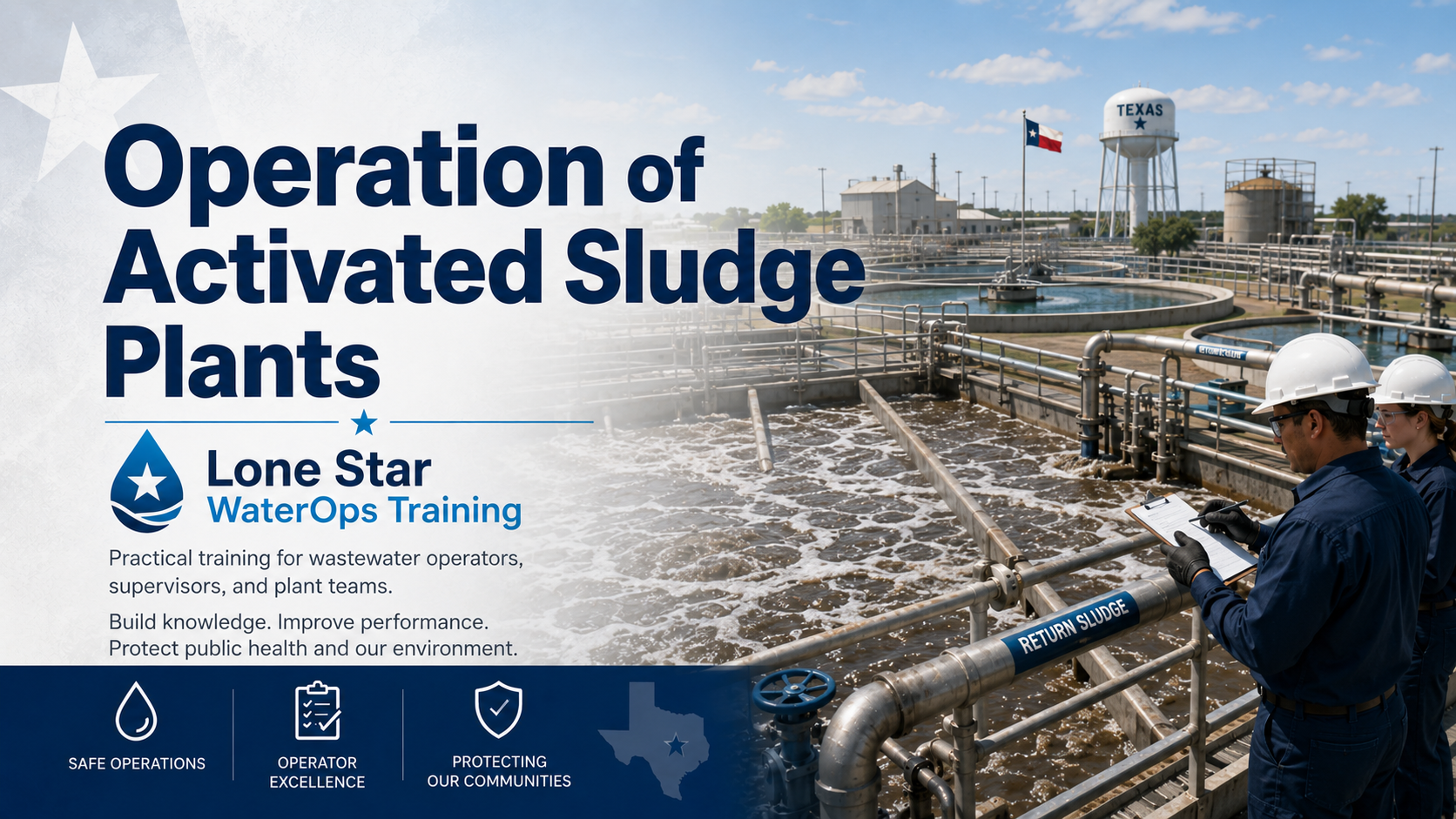
This specialized course examines the biological principles and operational controls associated with activated sludge wastewater treatment. Topics include suspended-growth treatment, microbiology, aeration basins, secondary clarifiers, return activated sludge, waste activated sludge, dissolved oxygen control, sludge-age management, process-control calculations, nitrification, microscopic examination, and the evaluation of sludge-settling characteristics. Participants also learn to recognize and respond to common operational problems such as sludge bulking, foaming, poor settling, and process instability. 20-hour course
Prerequisites
There are no prerequisites for this course.
Course Completion Requirements
Participants must provide information for all required fields, including their U.S. citizenship/permanent resident status, and meet all attendance and course completion requirements. If this information is not provided, the participant may be considered incomplete and may not receive a certificate of completion.
Participant Must Provide
Simple calculator with square root function.
Photo identification on the first day of class. See the “Policy” page of the website for approved forms of identification and additional guidelines.
Course materials, notebook, and writing utensils as directed by the instructor.
Attendance Requirements
Class attendance is an essential part of the education process. Participants are expected to attend all class sessions, activities, discussions, and required exercises. This course requires participants to attend a minimum of 100% of the class hours as a component of successful course completion. During the course, the instructor will review any additional attendance or participation requirements.
Recommended Prior Training Courses or Knowledge
Prior completion of Basic Wastewater Operations and Wastewater Treatment is recommended but not required. Participants should have basic familiarity with biological treatment, aeration, clarification, solids handling, and wastewater process monitoring.
Upon Successful Completion, Participants Will Be Able To
Explain the fundamentals of the activated sludge process and biological wastewater treatment.
Identify key process control parameters, including dissolved oxygen, MLSS, MLVSS, SVI, sludge age, F/M ratio, return activated sludge, and waste activated sludge.
Recognize common activated sludge problems, including bulking, foaming, rising sludge, pin floc, and poor settling.
Evaluate operational adjustments related to aeration, sludge wasting, return rates, and clarifier performance.
Apply process control concepts to improve treatment efficiency and effluent quality.
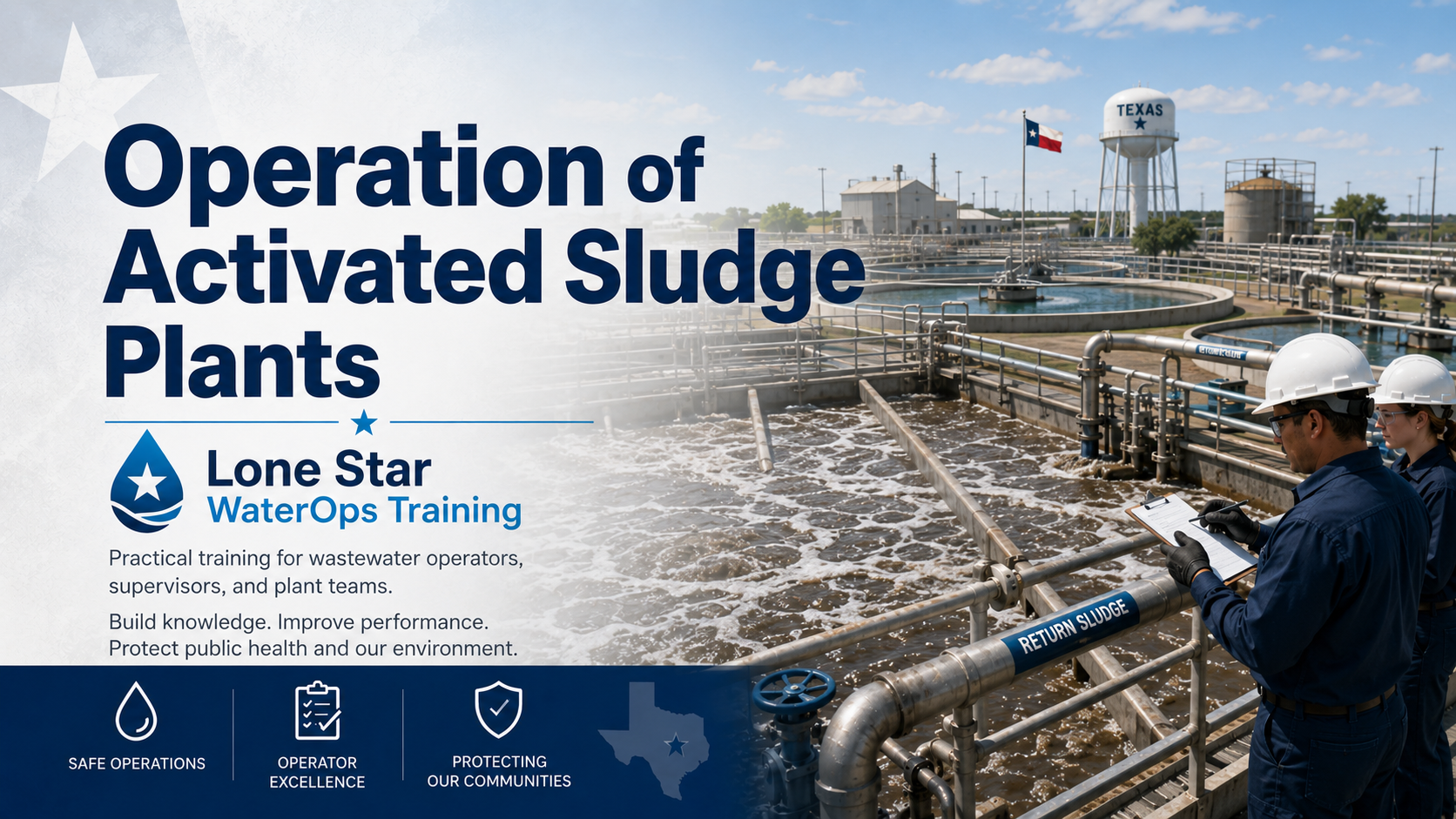
This specialized course examines the biological principles and operational controls associated with activated sludge wastewater treatment. Topics include suspended-growth treatment, microbiology, aeration basins, secondary clarifiers, return activated sludge, waste activated sludge, dissolved oxygen control, sludge-age management, process-control calculations, nitrification, microscopic examination, and the evaluation of sludge-settling characteristics. Participants also learn to recognize and respond to common operational problems such as sludge bulking, foaming, poor settling, and process instability. 20-hour course
Prerequisites
There are no prerequisites for this course.
Course Completion Requirements
Participants must provide information for all required fields, including their U.S. citizenship/permanent resident status, and meet all attendance and course completion requirements. If this information is not provided, the participant may be considered incomplete and may not receive a certificate of completion.
Participant Must Provide
Simple calculator with square root function.
Photo identification on the first day of class. See the “Policy” page of the website for approved forms of identification and additional guidelines.
Course materials, notebook, and writing utensils as directed by the instructor.
Attendance Requirements
Class attendance is an essential part of the education process. Participants are expected to attend all class sessions, activities, discussions, and required exercises. This course requires participants to attend a minimum of 100% of the class hours as a component of successful course completion. During the course, the instructor will review any additional attendance or participation requirements.
Recommended Prior Training Courses or Knowledge
Prior completion of Basic Wastewater Operations and Wastewater Treatment is recommended but not required. Participants should have basic familiarity with biological treatment, aeration, clarification, solids handling, and wastewater process monitoring.
Upon Successful Completion, Participants Will Be Able To
Explain the fundamentals of the activated sludge process and biological wastewater treatment.
Identify key process control parameters, including dissolved oxygen, MLSS, MLVSS, SVI, sludge age, F/M ratio, return activated sludge, and waste activated sludge.
Recognize common activated sludge problems, including bulking, foaming, rising sludge, pin floc, and poor settling.
Evaluate operational adjustments related to aeration, sludge wasting, return rates, and clarifier performance.
Apply process control concepts to improve treatment efficiency and effluent quality.
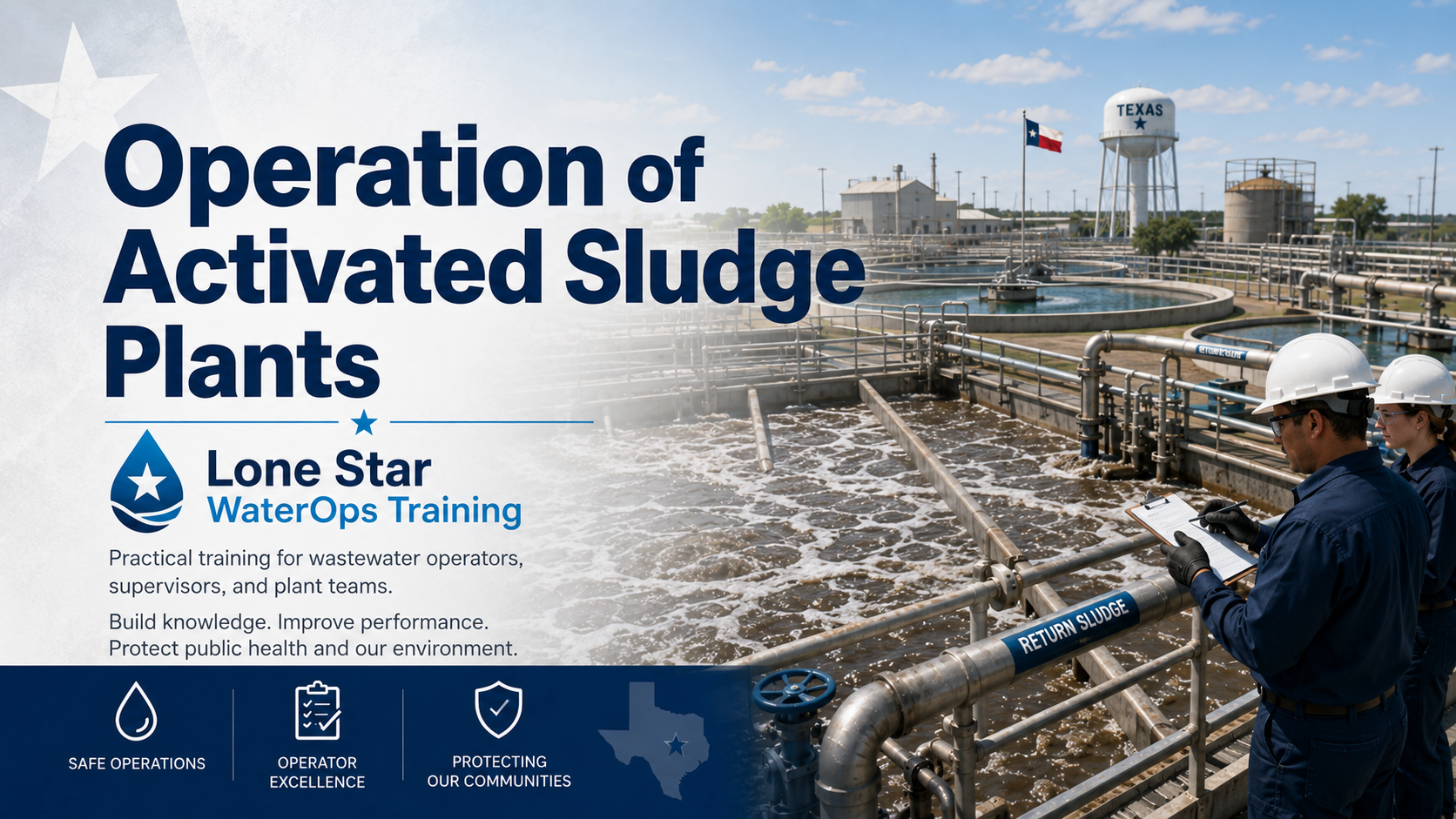
This specialized course examines the biological principles and operational controls associated with activated sludge wastewater treatment. Topics include suspended-growth treatment, microbiology, aeration basins, secondary clarifiers, return activated sludge, waste activated sludge, dissolved oxygen control, sludge-age management, process-control calculations, nitrification, microscopic examination, and the evaluation of sludge-settling characteristics. Participants also learn to recognize and respond to common operational problems such as sludge bulking, foaming, poor settling, and process instability. 20-hour course
Prerequisites
There are no prerequisites for this course.
Course Completion Requirements
Participants must provide information for all required fields, including their U.S. citizenship/permanent resident status, and meet all attendance and course completion requirements. If this information is not provided, the participant may be considered incomplete and may not receive a certificate of completion.
Participant Must Provide
Simple calculator with square root function.
Photo identification on the first day of class. See the “Policy” page of the website for approved forms of identification and additional guidelines.
Course materials, notebook, and writing utensils as directed by the instructor.
Attendance Requirements
Class attendance is an essential part of the education process. Participants are expected to attend all class sessions, activities, discussions, and required exercises. This course requires participants to attend a minimum of 100% of the class hours as a component of successful course completion. During the course, the instructor will review any additional attendance or participation requirements.
Recommended Prior Training Courses or Knowledge
Prior completion of Basic Wastewater Operations and Wastewater Treatment is recommended but not required. Participants should have basic familiarity with biological treatment, aeration, clarification, solids handling, and wastewater process monitoring.
Upon Successful Completion, Participants Will Be Able To
Explain the fundamentals of the activated sludge process and biological wastewater treatment.
Identify key process control parameters, including dissolved oxygen, MLSS, MLVSS, SVI, sludge age, F/M ratio, return activated sludge, and waste activated sludge.
Recognize common activated sludge problems, including bulking, foaming, rising sludge, pin floc, and poor settling.
Evaluate operational adjustments related to aeration, sludge wasting, return rates, and clarifier performance.
Apply process control concepts to improve treatment efficiency and effluent quality.
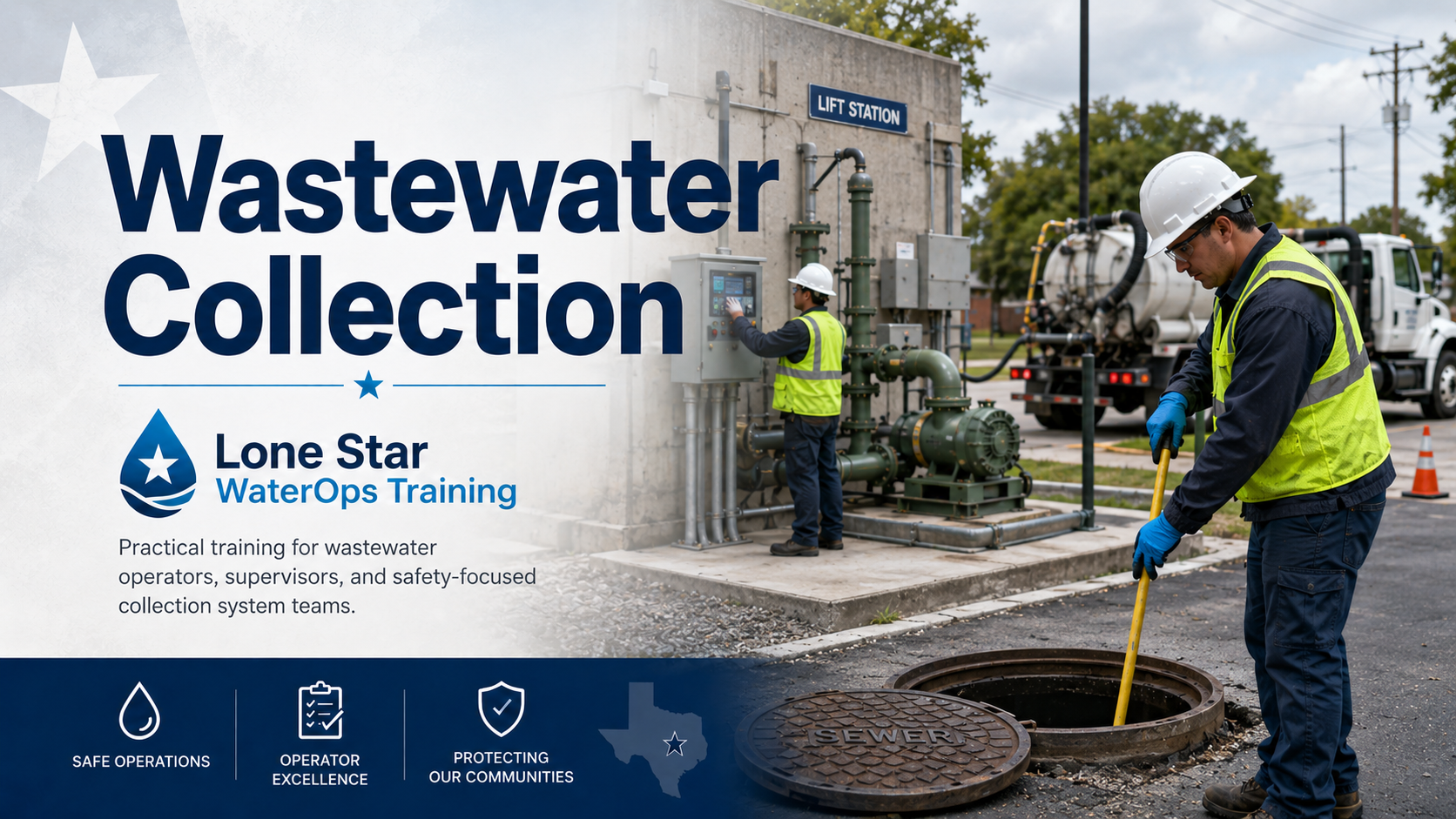
This course provides instruction in the operation, maintenance, and management of wastewater collection systems. Topics include the purpose and importance of wastewater collection, regulatory requirements, system design, sewer construction, gravity mains, force mains, manholes, lift stations, pumps, infiltration and inflow, stoppage prevention, inspection, cleaning, rehabilitation, industrial waste monitoring, and routine maintenance procedures. Participants also apply calculations associated with collection-system flow, capacity, pumping, and operational troubleshooting.
Prerequisites
There are no prerequisites for this course.
Course Completion Requirements
Participants must provide information for all required fields, including their U.S. citizenship/permanent resident status, and meet all attendance and course completion requirements. If this information is not provided, the participant may be considered incomplete and may not receive a certificate of completion.
Participant Must Provide
Simple calculator with square root function.
Photo identification on the first day of class. See the “Policy” page of the website for approved forms of identification and additional guidelines.
Course materials, notebook, and writing utensils as directed by the instructor.
Attendance Requirements
Class attendance is an essential part of the education process. Participants are expected to attend all class sessions, activities, discussions, and required exercises. This course requires participants to attend a minimum of 100% of the class hours as a component of successful course completion. During the course, the instructor will review any additional attendance or participation requirements.
Recommended Prior Training Courses or Knowledge
Prior completion of Basic Wastewater Operations or equivalent utility experience is recommended but not required. Participants should have basic familiarity with wastewater systems, utility field work, safety, and public infrastructure.
Upon Successful Completion, Participants Will Be Able To
Identify major components of wastewater collection systems, including mains, manholes, lift stations, force mains, and service laterals.
Explain collection system operation, inspection, cleaning, maintenance, and troubleshooting practices.
Recognize problems involving inflow and infiltration, blockages, sewer overflows, corrosion, and odor control.
Describe safety concerns related to traffic control, confined spaces, gases, excavation, and equipment use.
Apply practical collection system knowledge to support reliable and compliant wastewater service.
This course provides instruction in the operation, maintenance, and management of wastewater collection systems. Topics include the purpose and importance of wastewater collection, regulatory requirements, system design, sewer construction, gravity mains, force mains, manholes, lift stations, pumps, infiltration and inflow, stoppage prevention, inspection, cleaning, rehabilitation, industrial waste monitoring, and routine maintenance procedures. Participants also apply calculations associated with collection-system flow, capacity, pumping, and operational troubleshooting.
Prerequisites
There are no prerequisites for this course.
Course Completion Requirements
Participants must provide information for all required fields, including their U.S. citizenship/permanent resident status, and meet all attendance and course completion requirements. If this information is not provided, the participant may be considered incomplete and may not receive a certificate of completion.
Participant Must Provide
Simple calculator with square root function.
Photo identification on the first day of class. See the “Policy” page of the website for approved forms of identification and additional guidelines.
Course materials, notebook, and writing utensils as directed by the instructor.
Attendance Requirements
Class attendance is an essential part of the education process. Participants are expected to attend all class sessions, activities, discussions, and required exercises. This course requires participants to attend a minimum of 100% of the class hours as a component of successful course completion. During the course, the instructor will review any additional attendance or participation requirements.
Recommended Prior Training Courses or Knowledge
Prior completion of Basic Wastewater Operations or equivalent utility experience is recommended but not required. Participants should have basic familiarity with wastewater systems, utility field work, safety, and public infrastructure.
Upon Successful Completion, Participants Will Be Able To
Identify major components of wastewater collection systems, including mains, manholes, lift stations, force mains, and service laterals.
Explain collection system operation, inspection, cleaning, maintenance, and troubleshooting practices.
Recognize problems involving inflow and infiltration, blockages, sewer overflows, corrosion, and odor control.
Describe safety concerns related to traffic control, confined spaces, gases, excavation, and equipment use.
Apply practical collection system knowledge to support reliable and compliant wastewater service.
This course provides instruction in the operation, maintenance, and management of wastewater collection systems. Topics include the purpose and importance of wastewater collection, regulatory requirements, system design, sewer construction, gravity mains, force mains, manholes, lift stations, pumps, infiltration and inflow, stoppage prevention, inspection, cleaning, rehabilitation, industrial waste monitoring, and routine maintenance procedures. Participants also apply calculations associated with collection-system flow, capacity, pumping, and operational troubleshooting.
Prerequisites
There are no prerequisites for this course.
Course Completion Requirements
Participants must provide information for all required fields, including their U.S. citizenship/permanent resident status, and meet all attendance and course completion requirements. If this information is not provided, the participant may be considered incomplete and may not receive a certificate of completion.
Participant Must Provide
Simple calculator with square root function.
Photo identification on the first day of class. See the “Policy” page of the website for approved forms of identification and additional guidelines.
Course materials, notebook, and writing utensils as directed by the instructor.
Attendance Requirements
Class attendance is an essential part of the education process. Participants are expected to attend all class sessions, activities, discussions, and required exercises. This course requires participants to attend a minimum of 100% of the class hours as a component of successful course completion. During the course, the instructor will review any additional attendance or participation requirements.
Recommended Prior Training Courses or Knowledge
Prior completion of Basic Wastewater Operations or equivalent utility experience is recommended but not required. Participants should have basic familiarity with wastewater systems, utility field work, safety, and public infrastructure.
Upon Successful Completion, Participants Will Be Able To
Identify major components of wastewater collection systems, including mains, manholes, lift stations, force mains, and service laterals.
Explain collection system operation, inspection, cleaning, maintenance, and troubleshooting practices.
Recognize problems involving inflow and infiltration, blockages, sewer overflows, corrosion, and odor control.
Describe safety concerns related to traffic control, confined spaces, gases, excavation, and equipment use.
Apply practical collection system knowledge to support reliable and compliant wastewater service.
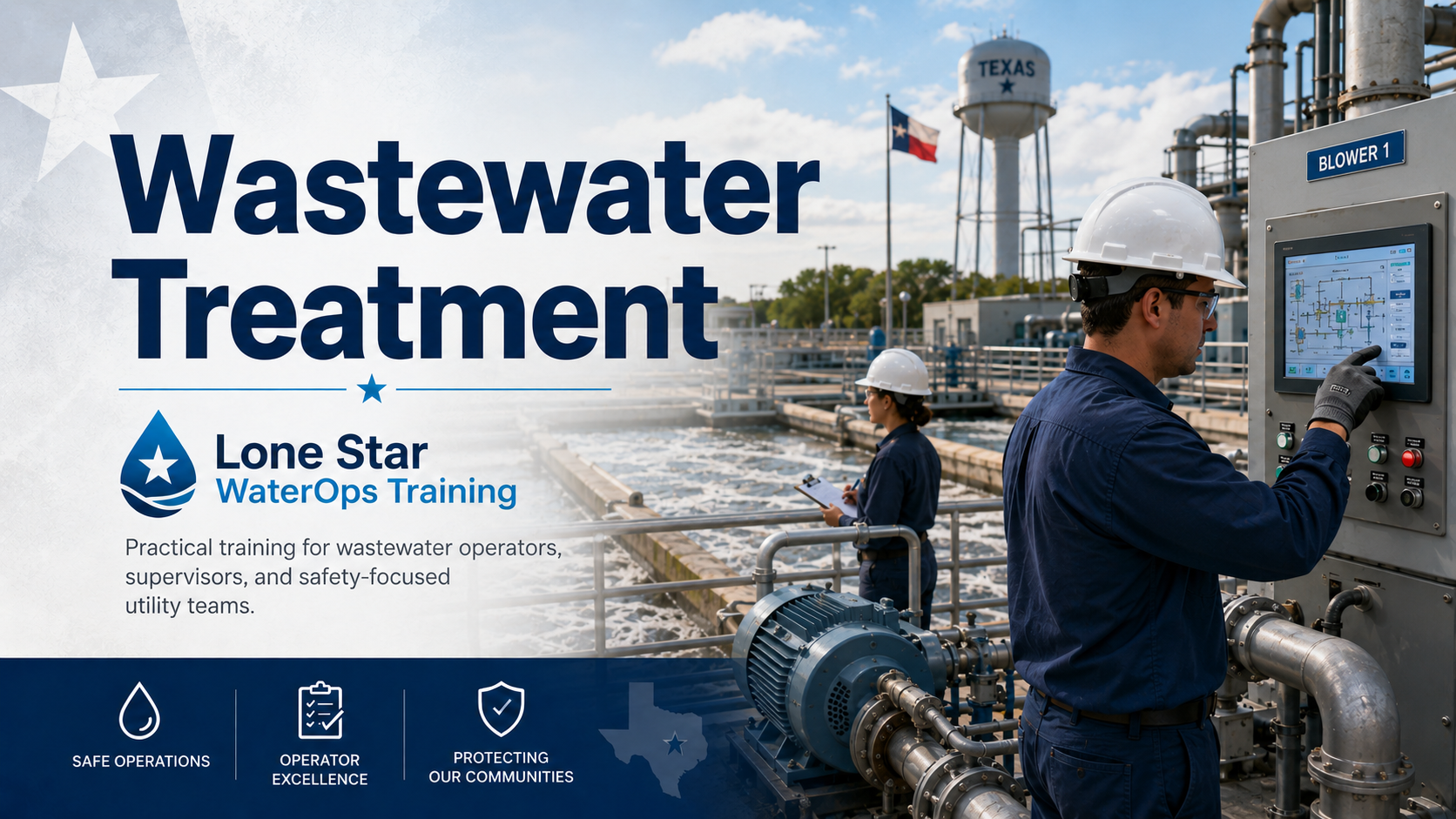
This course addresses the practical operation and maintenance of municipal wastewater treatment facilities. Participants study wastewater composition and characteristics, state regulatory requirements, preliminary and secondary treatment, biological treatment processes, activated sludge, stabilization ponds, advanced treatment, solids handling, disinfection, laboratory process control, industrial waste monitoring, operational safety, and wastewater calculations. The course emphasizes using operating data, established procedures, and safe work practices to maintain effective treatment and regulatory compliance. 20 Hour Course
Prerequisites
There are no prerequisites for this course.
Course Completion Requirements
Participants must provide information for all required fields, including their U.S. citizenship/permanent resident information, in addition to meeting all attendance and course completion requirements. If this information is not provided, the participant may be considered incomplete and may not receive a certificate of completion.
Participant Must Provide
Simple calculator with square root function.
Photo identification on the first day of class. See the “Policy” page of the website for approved forms of identification and additional guidelines.
Course materials, notebook, and writing utensils as directed by the instructor.
Attendance Requirements
Class attendance is an essential part of the education process. Participants are expected to attend all class sessions, activities, discussions, and required exercises. This course requires participants to attend a minimum of 100% of the class hours as a component of successful course completion. During the course, the instructor will review any additional attendance or participation requirements.
Recommended Prior Training Courses or Knowledge
Prior completion of Basic Wastewater Operations is recommended but not required. Participants should have a basic understanding of wastewater characteristics, collection systems, treatment goals, and operator responsibilities.
Upon Successful Completion, Participants Will Be Able To
Describe primary, secondary, and disinfection treatment processes used in wastewater treatment facilities.
Explain the purpose of preliminary treatment, sedimentation, biological treatment, clarification, solids handling, and effluent quality monitoring.
Identify common process control indicators and operational concerns in wastewater treatment.
Recognize safety, sampling, recordkeeping, and permit compliance responsibilities.
Apply basic wastewater treatment knowledge to support effective plant operation.
This course addresses the practical operation and maintenance of municipal wastewater treatment facilities. Participants study wastewater composition and characteristics, state regulatory requirements, preliminary and secondary treatment, biological treatment processes, activated sludge, stabilization ponds, advanced treatment, solids handling, disinfection, laboratory process control, industrial waste monitoring, operational safety, and wastewater calculations. The course emphasizes using operating data, established procedures, and safe work practices to maintain effective treatment and regulatory compliance. 20 Hour Course
Prerequisites
There are no prerequisites for this course.
Course Completion Requirements
Participants must provide information for all required fields, including their U.S. citizenship/permanent resident status, and meet all attendance and course completion requirements. If this information is not provided, the participant may be considered incomplete and may not receive a certificate of completion.
Participant Must Provide
Simple calculator with square root function.
Photo identification on the first day of class. See the “Policy” page of the website for approved forms of identification and additional guidelines.
Course materials, notebook, and writing utensils as directed by the instructor.
Attendance Requirements
Class attendance is an essential part of the education process. Participants are expected to attend all class sessions, activities, discussions, and required exercises. This course requires participants to attend at least 100% of class hours as a condition for successful course completion. During the course, the instructor will review any additional attendance or participation requirements.
Recommended Prior Training Courses or Knowledge
Prior completion of Basic Wastewater Operations is recommended but not required. Participants should have a basic understanding of wastewater characteristics, collection systems, treatment goals, and operator responsibilities.
Upon Successful Completion, Participants Will Be Able To
Describe primary, secondary, and disinfection treatment processes used in wastewater treatment facilities.
Explain the purpose of preliminary treatment, sedimentation, biological treatment, clarification, solids handling, and effluent quality monitoring.
Identify common process control indicators and operational concerns in wastewater treatment.
Recognize safety, sampling, recordkeeping, and permit compliance responsibilities.
Apply basic wastewater treatment knowledge to support effective plant operation.
This course prepares wastewater operators and laboratory personnel to produce accurate, reliable, and defensible analytical data. Instruction covers laboratory safety, equipment use, sampling procedures, quality assurance and quality control, recordkeeping, and regulatory reporting. Participants study standard wastewater analyses, including temperature, pH, dissolved oxygen, biochemical oxygen demand, total suspended solids, ammonia nitrogen, phosphorus, alkalinity, chlorine residual, solids analysis, and microbiological testing. Emphasis is placed on interpreting laboratory results and using analytical data to evaluate and control wastewater-treatment processes. 20 Hour Course
Prerequisites
There are no prerequisites for this course.
Course Completion Requirements
Participants must provide information for all required fields, including their U.S. citizenship/permanent resident status, and meet all attendance and course completion requirements. If this information is not provided, the participant may be considered incomplete and may not receive a certificate of completion.
Participant Must Provide
Simple calculator with square root function.
Photo identification on the first day of class. See the “Policy” page of the website for approved forms of identification and additional guidelines.
Course materials, notebook, and writing utensils as directed by the instructor.
Attendance Requirements
Class attendance is an essential part of the education process. Participants are expected to attend all class sessions, activities, discussions, and required exercises. This course requires participants to attend at least 100% of class hours as a condition for successful course completion. During the course, the instructor will review any additional attendance or participation requirements.
Recommended Prior Training Courses or Knowledge
Prior completion of Basic Wastewater Operations is recommended but not required. Participants should have a basic understanding of wastewater characteristics, collection systems, treatment goals, and operator responsibilities.
Upon Successful Completion, Participants Will Be Able To
Describe primary, secondary, and disinfection treatment processes used in wastewater treatment facilities.
Explain the purpose of preliminary treatment, sedimentation, biological treatment, clarification, solids handling, and effluent quality monitoring.
Identify common process control indicators and operational concerns in wastewater treatment.
Recognize safety, sampling, recordkeeping, and permit compliance responsibilities.
Apply basic wastewater treatment knowledge to support effective plant operation.
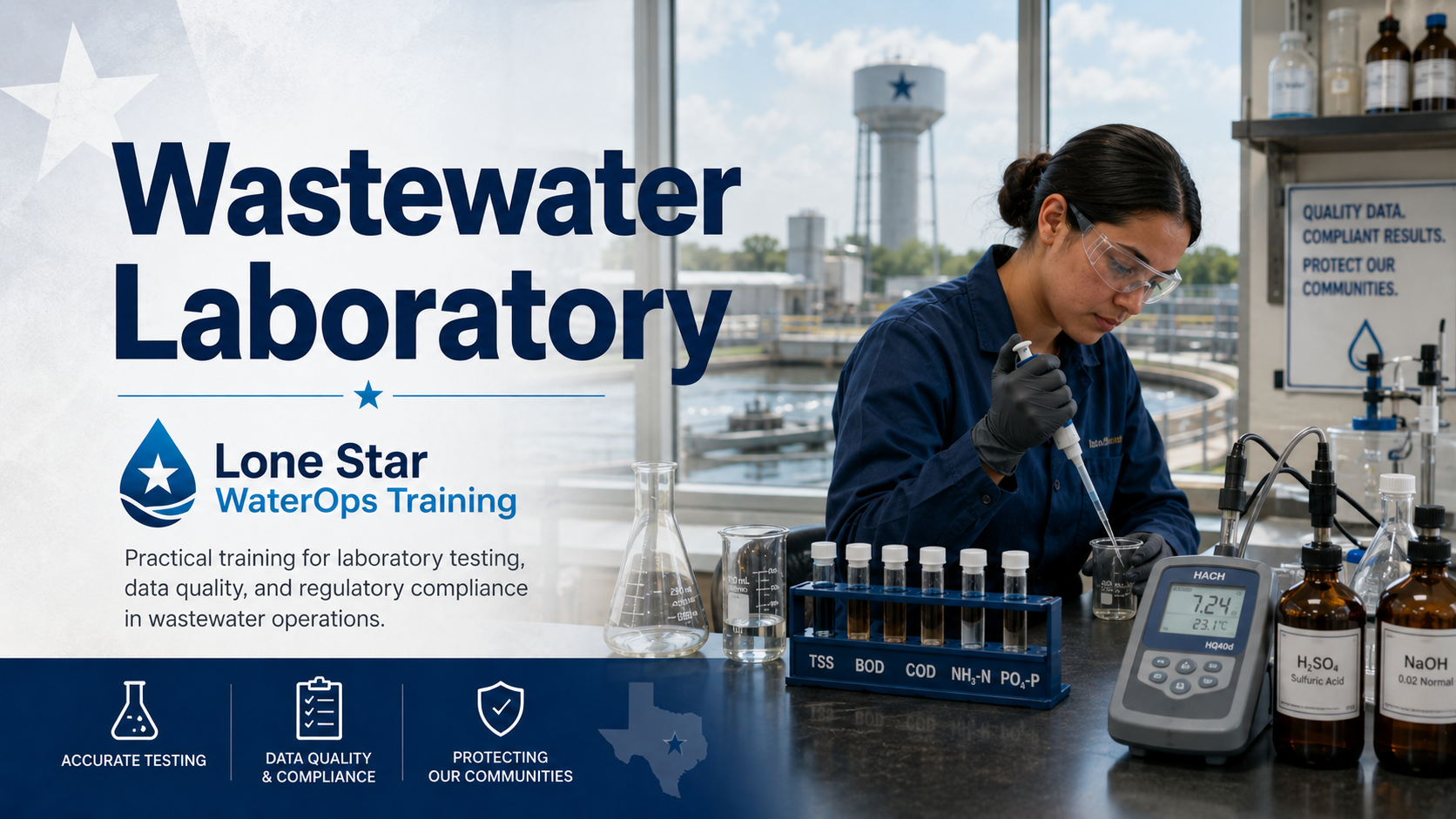
This course prepares wastewater operators and laboratory personnel to produce accurate, reliable, and defensible analytical data. Instruction covers laboratory safety, equipment use, sampling procedures, quality assurance and quality control, recordkeeping, and regulatory reporting. Participants study standard wastewater analyses, including temperature, pH, dissolved oxygen, biochemical oxygen demand, total suspended solids, ammonia nitrogen, phosphorus, alkalinity, chlorine residual, solids analysis, and microbiological testing. Emphasis is placed on interpreting laboratory results and using analytical data to evaluate and control wastewater-treatment processes. 20 Hour Course
Prerequisites
There are no prerequisites for this course.
Course Completion Requirements
Participants must provide information for all required fields, including their U.S. citizenship/permanent resident status, and meet all attendance and course completion requirements. If this information is not provided, the participant may be considered incomplete and may not receive a certificate of completion.
Participant Must Provide
Simple calculator with square root function.
Photo identification on the first day of class. See the “Policy” page of the website for approved forms of identification and additional guidelines.
Course materials, notebook, and writing utensils as directed by the instructor.
Attendance Requirements
Class attendance is an essential part of the education process. Participants are expected to attend all class sessions, activities, discussions, and required exercises. This course requires participants to attend at least 100% of class hours as a condition for successful course completion. During the course, the instructor will review any additional attendance or participation requirements.
Recommended Prior Training Courses or Knowledge
Prior completion of Basic Wastewater Operations or Wastewater Treatment is recommended but not required. Participants should have a basic understanding of wastewater treatment processes, sampling, permit monitoring, and laboratory safety.
Upon Successful Completion, Participants Will Be Able To
Describe common wastewater laboratory tests and their operational significance.
Explain proper sampling, sample handling, preservation, chain of custody, and documentation practices.
Identify laboratory methods related to pH, dissolved oxygen, chlorine residual, BOD, COD, TSS, ammonia, solids, and other wastewater monitoring parameters.
Recognize quality assurance, quality control, calibration, safety, and recordkeeping requirements.
Apply laboratory results to support treatment decisions, process control, and permit compliance.
This course prepares wastewater operators and laboratory personnel to produce accurate, reliable, and defensible analytical data. Instruction covers laboratory safety, equipment use, sampling procedures, quality assurance and quality control, recordkeeping, and regulatory reporting. Participants study standard wastewater analyses, including temperature, pH, dissolved oxygen, biochemical oxygen demand, total suspended solids, ammonia nitrogen, phosphorus, alkalinity, chlorine residual, solids analysis, and microbiological testing. Emphasis is placed on interpreting laboratory results and using analytical data to evaluate and control wastewater-treatment processes. 20 Hour Course
Prerequisites
There are no prerequisites for this course.
Course Completion Requirements
Participants must provide information for all required fields, including their U.S. citizenship/permanent resident status, and meet all attendance and course completion requirements. If this information is not provided, the participant may be considered incomplete and may not receive a certificate of completion.
Participant Must Provide
Simple calculator with square root function.
Photo identification on the first day of class. See the “Policy” page of the website for approved forms of identification and additional guidelines.
Course materials, notebook, and writing utensils as directed by the instructor.
Attendance Requirements
Class attendance is an essential part of the education process. Participants are expected to attend all class sessions, activities, discussions, and required exercises. This course requires participants to attend at least 100% of class hours as a condition for successful course completion. During the course, the instructor will review any additional attendance or participation requirements.
Recommended Prior Training Courses or Knowledge
Prior completion of Basic Wastewater Operations or Wastewater Treatment is recommended but not required. Participants should have a basic understanding of wastewater treatment processes, sampling, permit monitoring, and laboratory safety.
Upon Successful Completion, Participants Will Be Able To
Describe common wastewater laboratory tests and their operational significance.
Explain proper sampling, sample handling, preservation, chain of custody, and documentation practices.
Identify laboratory methods related to pH, dissolved oxygen, chlorine residual, BOD, COD, TSS, ammonia, solids, and other wastewater monitoring parameters.
Recognize quality assurance, quality control, calibration, safety, and recordkeeping requirements.
Apply laboratory results to support treatment decisions, process control, and permit compliance.
This course prepares wastewater operators and laboratory personnel to produce accurate, reliable, and defensible analytical data. Instruction covers laboratory safety, equipment use, sampling procedures, quality assurance and quality control, recordkeeping, and regulatory reporting. Participants study standard wastewater analyses, including temperature, pH, dissolved oxygen, biochemical oxygen demand, total suspended solids, ammonia nitrogen, phosphorus, alkalinity, chlorine residual, solids analysis, and microbiological testing. Emphasis is placed on interpreting laboratory results and using analytical data to evaluate and control wastewater-treatment processes. 20 Hour Course
Prerequisites
There are no prerequisites for this course.
Course Completion Requirements
Participants must provide information for all required fields, including their U.S. citizenship/permanent resident status, and meet all attendance and course completion requirements. If this information is not provided, the participant may be considered incomplete and may not receive a certificate of completion.
Participant Must Provide
Simple calculator with square root function.
Photo identification on the first day of class. See the “Policy” page of the website for approved forms of identification and additional guidelines.
Course materials, notebook, and writing utensils as directed by the instructor.
Attendance Requirements
Class attendance is an essential part of the education process. Participants are expected to attend all class sessions, activities, discussions, and required exercises. This course requires participants to attend at least 100% of class hours as a condition for successful course completion. During the course, the instructor will review any additional attendance or participation requirements.
Recommended Prior Training Courses or Knowledge
Prior completion of Basic Wastewater Operations or Wastewater Treatment is recommended but not required. Participants should have a basic understanding of wastewater treatment processes, sampling, permit monitoring, and laboratory safety.
Upon Successful Completion, Participants Will Be Able To
Describe common wastewater laboratory tests and their operational significance.
Explain proper sampling, sample handling, preservation, chain of custody, and documentation practices.
Identify laboratory methods related to pH, dissolved oxygen, chlorine residual, BOD, COD, TSS, ammonia, solids, and other wastewater monitoring parameters.
Recognize quality assurance, quality control, calibration, safety, and recordkeeping requirements.
Apply laboratory results to support treatment decisions, process control, and permit compliance.
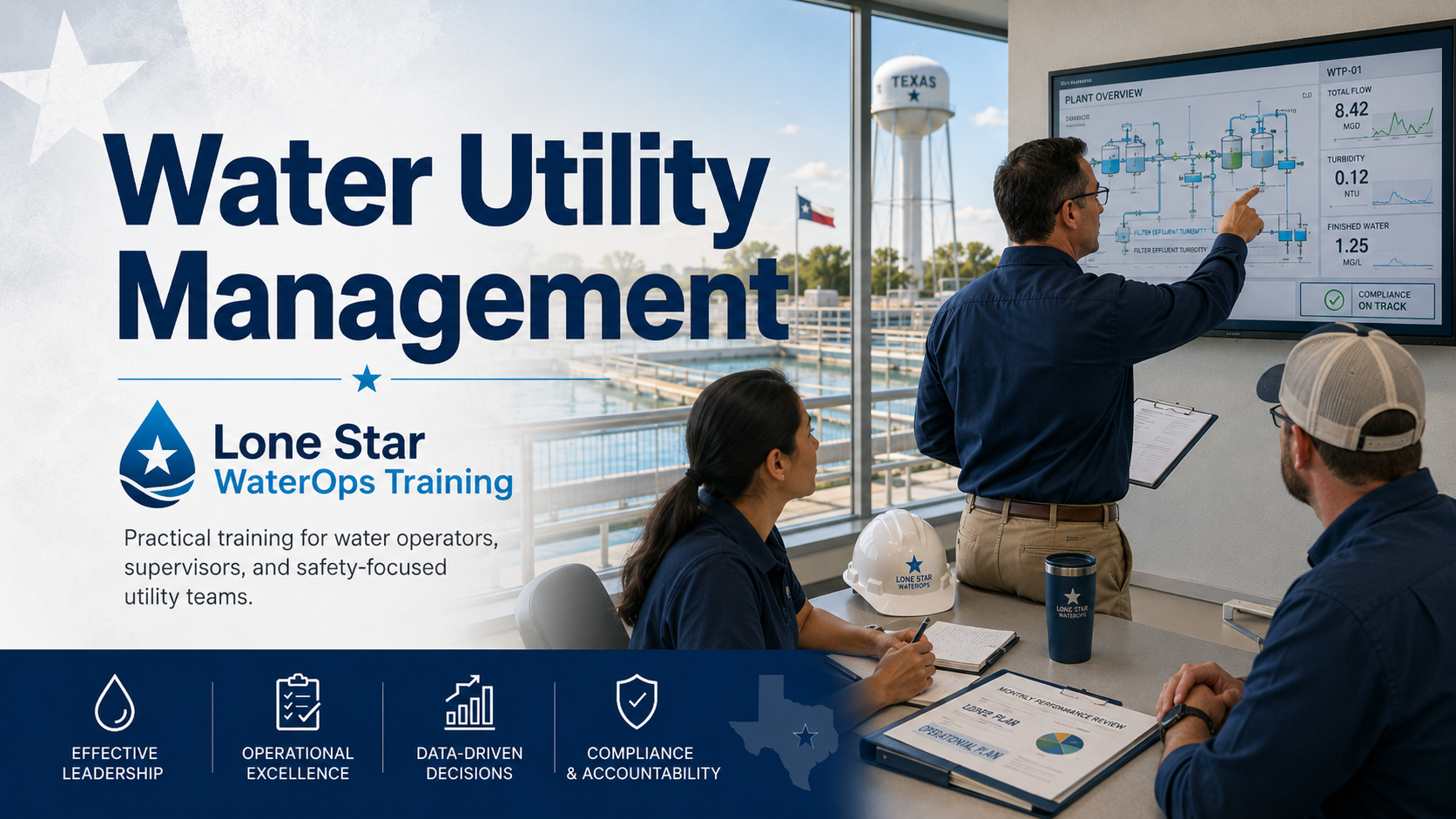
This course provides instruction in the effective management of drinking-water and wastewater utilities. Topics include management functions, organizational planning, regulatory compliance, governing-body responsibilities, recordkeeping, reporting, budgeting, financial management, engineering coordination, infrastructure planning, utility growth, workplace safety, physical security, and public relations. Participants learn how sound management practices support regulatory compliance, reliable utility service, workforce performance, responsible financial stewardship, and long-term system sustainability. 20 Hour Course
Prerequisites
There are no prerequisites for this course.
Course Completion Requirements
Participants must provide information for all required fields, including their U.S. citizenship/permanent resident status, and meet all attendance and course completion requirements. If this information is not provided, the participant may be considered incomplete and may not receive a certificate of completion.
Participant Must Provide
Simple calculator with square root function.
Photo identification on the first day of class. See the “Policy” page of the website for approved forms of identification and additional guidelines.
Course materials, notebook, and writing utensils as directed by the instructor.
Attendance Requirements
Class attendance is an essential part of the education process. Participants are expected to attend all class sessions, activities, discussions, and required exercises. This course requires participants to attend at least 100% of class hours as a condition for successful course completion. During the course, the instructor will review any additional attendance or participation requirements.
Recommended Prior Training Courses or Knowledge
Prior water utility experience is recommended. This course is especially useful for lead operators, supervisors, chief operators, utility managers, and operators preparing for higher-level licensing or leadership roles.
Upon Successful Completion, Participants Will Be Able To
Explain key responsibilities of water utility leadership and management.
Describe operational planning, staffing, budgeting, recordkeeping, compliance, customer service, and asset management considerations.
Evaluate management issues related to safety, emergency response, communication, and personnel supervision.
Recognize the importance of regulatory compliance, documentation, training, and accountability.
Apply practical leadership and management concepts to support reliable water utility operations.
This course provides instruction in the effective management of drinking-water and wastewater utilities. Topics include management functions, organizational planning, regulatory compliance, governing-body responsibilities, recordkeeping, reporting, budgeting, financial management, engineering coordination, infrastructure planning, utility growth, workplace safety, physical security, and public relations. Participants learn how sound management practices support regulatory compliance, reliable utility service, workforce performance, responsible financial stewardship, and long-term system sustainability. 20 Hour Course
Prerequisites
There are no prerequisites for this course.
Course Completion Requirements
Participants must provide information for all required fields, including their U.S. citizenship/permanent resident information, in addition to meeting all attendance and course completion requirements. If this information is not provided, the participant may be considered incomplete and may not receive a certificate of completion.
Participant Must Provide
Simple calculator with square root function.
Photo identification on the first day of class. See the Participant Handbook for approved forms of identification and additional guidelines.
Course materials, notebook, and writing utensils as directed by the instructor.
Attendance Requirements
Class attendance is an essential part of the education process. Participants are expected to attend all class sessions, activities, discussions, and required exercises. This course requires participants to attend a minimum of 100% of the class hours as a component of successful course completion. During the course, the instructor will review any additional attendance or participation requirements.
Recommended Prior Training Courses or Knowledge
Prior water utility experience is recommended. This course is especially useful for lead operators, supervisors, chief operators, utility managers, and operators preparing for higher-level licensing or leadership roles.
Upon Successful Completion, Participants Will Be Able To
Explain key responsibilities of water utility leadership and management.
Describe operational planning, staffing, budgeting, recordkeeping, compliance, customer service, and asset management considerations.
Evaluate management issues related to safety, emergency response, communication, and personnel supervision.
Recognize the importance of regulatory compliance, documentation, training, and accountability.
Apply practical leadership and management concepts to support reliable water utility operations.
This course provides instruction in the effective management of drinking-water and wastewater utilities. Topics include management functions, organizational planning, regulatory compliance, governing-body responsibilities, recordkeeping, reporting, budgeting, financial management, engineering coordination, infrastructure planning, utility growth, workplace safety, physical security, and public relations. Participants learn how sound management practices support regulatory compliance, reliable utility service, workforce performance, responsible financial stewardship, and long-term system sustainability. 20 Hour Course
Prerequisites
There are no prerequisites for this course.
Course Completion Requirements
Participants must provide information for all required fields, including their U.S. citizenship/permanent resident information, in addition to meeting all attendance and course completion requirements. If this information is not provided, the participant may be considered incomplete and may not receive a certificate of completion.
Participant Must Provide
Simple calculator with square root function.
Photo identification on the first day of class. See the “Policy” page of the website for approved forms of identification and additional guidelines.
Course materials, notebook, and writing utensils as directed by the instructor.
Attendance Requirements
Class attendance is an essential part of the education process. Participants are expected to attend all class sessions, activities, discussions, and required exercises. This course requires participants to attend a minimum of 100% of the class hours as a component of successful course completion. During the course, the instructor will review any additional attendance or participation requirements.
Recommended Prior Training Courses or Knowledge
Prior water utility experience is recommended. This course is especially useful for lead operators, supervisors, chief operators, utility managers, and operators preparing for higher-level licensing or leadership roles.
Upon Successful Completion, Participants Will Be Able To
Explain key responsibilities of water utility leadership and management.
Describe operational planning, staffing, budgeting, recordkeeping, compliance, customer service, and asset management considerations.
Evaluate management issues related to safety, emergency response, communication, and personnel supervision.
Recognize the importance of regulatory compliance, documentation, training, and accountability.
Apply practical leadership and management concepts to support reliable water utility operations.
No results found
No results match your search. Try removing a few filters.