
Water Utility Calculations -C.8.b | November 29th - December 1st, 2027 | Non-Member
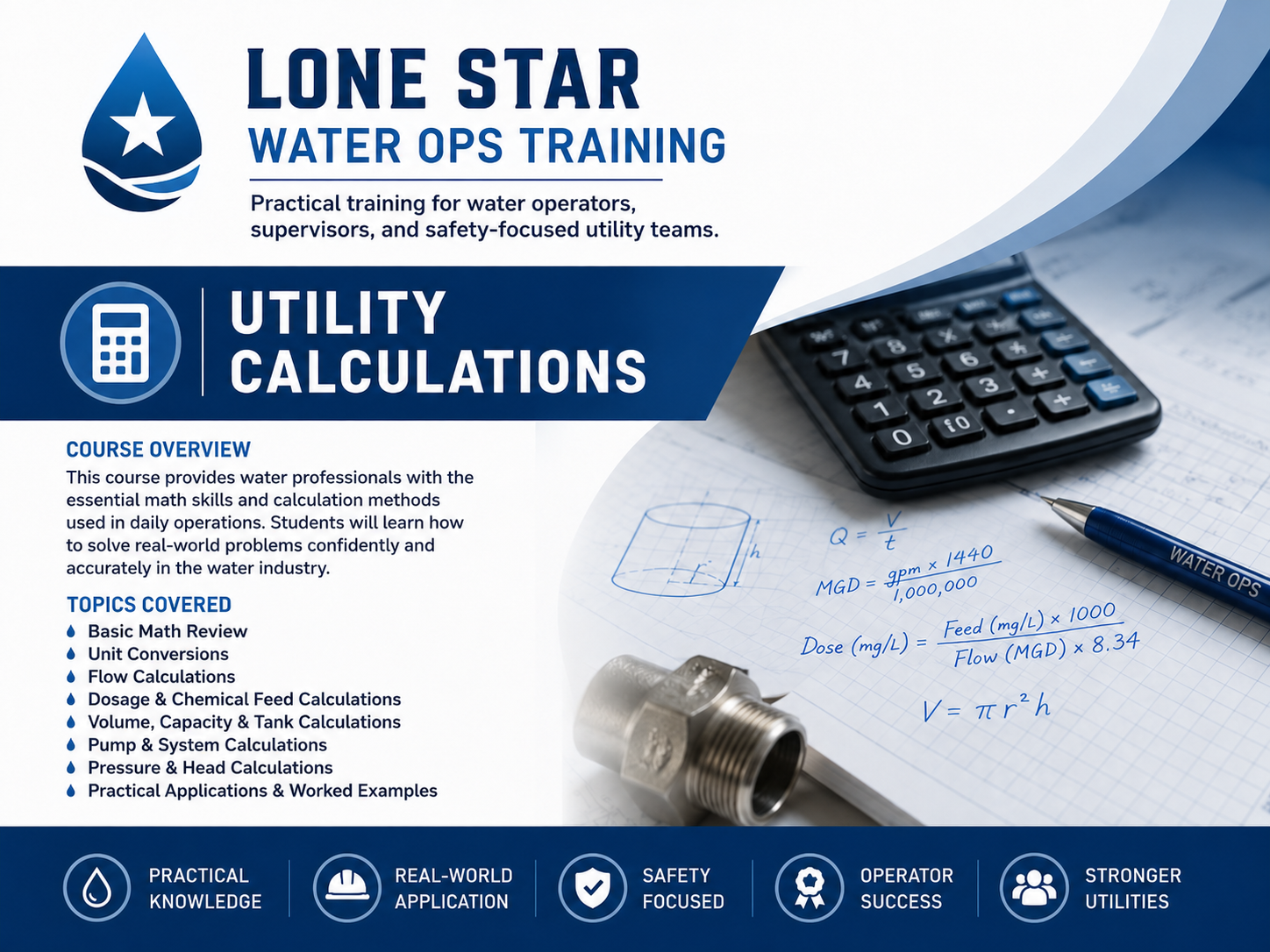
This course provides practical, operator-focused training on the math skills used in drinking water treatment and distribution. Students learn how to solve real-world problems involving flow, dosage, chemical feed, tank volume, detention time, pumping, pressure, unit conversions, and process control. This course helps water operators build confidence, improve accuracy, and prepare for TCEQ licensing requirements and daily field operations. 20-Hr Cours
Prerequisites
There are no prerequisites for this course.
Course Completion Requirements
Participants must provide information for all required fields, including their U.S. citizenship/permanent resident information, in addition to meeting all attendance and course completion requirements. If this information is not provided, the participant may be considered incomplete and may not receive a certificate of completion.
Participant Must Provide
Simple calculator with square root function.
Photo identification on the first day of class. See the “Policy” page of the website for approved forms of identification and additional guidelines.
Course materials, notebook, and writing utensils as directed by the instructor.
Access to any required course handouts, formula sheets, or calculation worksheets provided by the instructor.
Attendance Requirements
Class attendance is an essential part of the education process. Participants are expected to attend all class sessions, activities, discussions, and required exercises. This course requires participants to attend a minimum of 100% of the class hours as a component of successful course completion. During the course, the instructor will review any additional attendance, participation, or exercise requirements.
Recommended Prior Training Courses or Knowledge
Prior completion of Basic Water Operations or equivalent water utility experience is recommended but not required. Participants should have basic familiarity with drinking water treatment, distribution, pumping, storage, chemical feed, and common operator responsibilities. Basic math skills are helpful, but the course is designed to review and reinforce practical calculation methods step by step.
Upon Successful Completion, Participants Will Be Able To
Perform basic math operations commonly used in water utility work.
Convert units used in drinking water treatment, distribution, pumping, storage, and chemical-feed applications.
Calculate flow rates using gallons per minute, million gallons per day, and related operational units.
Calculate chemical dosage, feed rates, solution strength, and chemical application rates.
Determine tank volume, storage capacity, detention time, and related process-control values.
Solve pump, pressure, head, and system-related calculations used in daily water operations.
Apply formulas accurately using a simple calculator with square root function.
Evaluate real-world water utility problems using organized, step-by-step calculation methods.
Use calculation results to support safe, effective, and compliant water system operations.
This course provides practical, operator-focused training on the math skills used in drinking water treatment and distribution. Students learn how to solve real-world problems involving flow, dosage, chemical feed, tank volume, detention time, pumping, pressure, unit conversions, and process control. This course helps water operators build confidence, improve accuracy, and prepare for TCEQ licensing requirements and daily field operations. 20-Hr Cours
Prerequisites
There are no prerequisites for this course.
Course Completion Requirements
Participants must provide information for all required fields, including their U.S. citizenship/permanent resident information, in addition to meeting all attendance and course completion requirements. If this information is not provided, the participant may be considered incomplete and may not receive a certificate of completion.
Participant Must Provide
Simple calculator with square root function.
Photo identification on the first day of class. See the “Policy” page of the website for approved forms of identification and additional guidelines.
Course materials, notebook, and writing utensils as directed by the instructor.
Access to any required course handouts, formula sheets, or calculation worksheets provided by the instructor.
Attendance Requirements
Class attendance is an essential part of the education process. Participants are expected to attend all class sessions, activities, discussions, and required exercises. This course requires participants to attend a minimum of 100% of the class hours as a component of successful course completion. During the course, the instructor will review any additional attendance, participation, or exercise requirements.
Recommended Prior Training Courses or Knowledge
Prior completion of Basic Water Operations or equivalent water utility experience is recommended but not required. Participants should have basic familiarity with drinking water treatment, distribution, pumping, storage, chemical feed, and common operator responsibilities. Basic math skills are helpful, but the course is designed to review and reinforce practical calculation methods step by step.
Upon Successful Completion, Participants Will Be Able To
Perform basic math operations commonly used in water utility work.
Convert units used in drinking water treatment, distribution, pumping, storage, and chemical-feed applications.
Calculate flow rates using gallons per minute, million gallons per day, and related operational units.
Calculate chemical dosage, feed rates, solution strength, and chemical application rates.
Determine tank volume, storage capacity, detention time, and related process-control values.
Solve pump, pressure, head, and system-related calculations used in daily water operations.
Apply formulas accurately using a simple calculator with square root function.
Evaluate real-world water utility problems using organized, step-by-step calculation methods.
Use calculation results to support safe, effective, and compliant water system operations.