
Register Today *
Invest in Yourself. *
Advance Your Career. *
Register Today * Invest in Yourself. * Advance Your Career. *
Online Course Technology Requirements
All courses are delivered entirely online through Google Meet. Participants must have access to a reliable computer or laptop, a stable high-speed internet connection, a working microphone, and a functioning webcam. Participants are responsible for confirming that their equipment and internet connection are working properly before the course begins. Access to Google Meet is required to attend, participate in course activities, verify attendance, and meet all course-completion requirements.
TCEQ Water Core Courses
TCEQ Water Core Courses
Filters
Filters
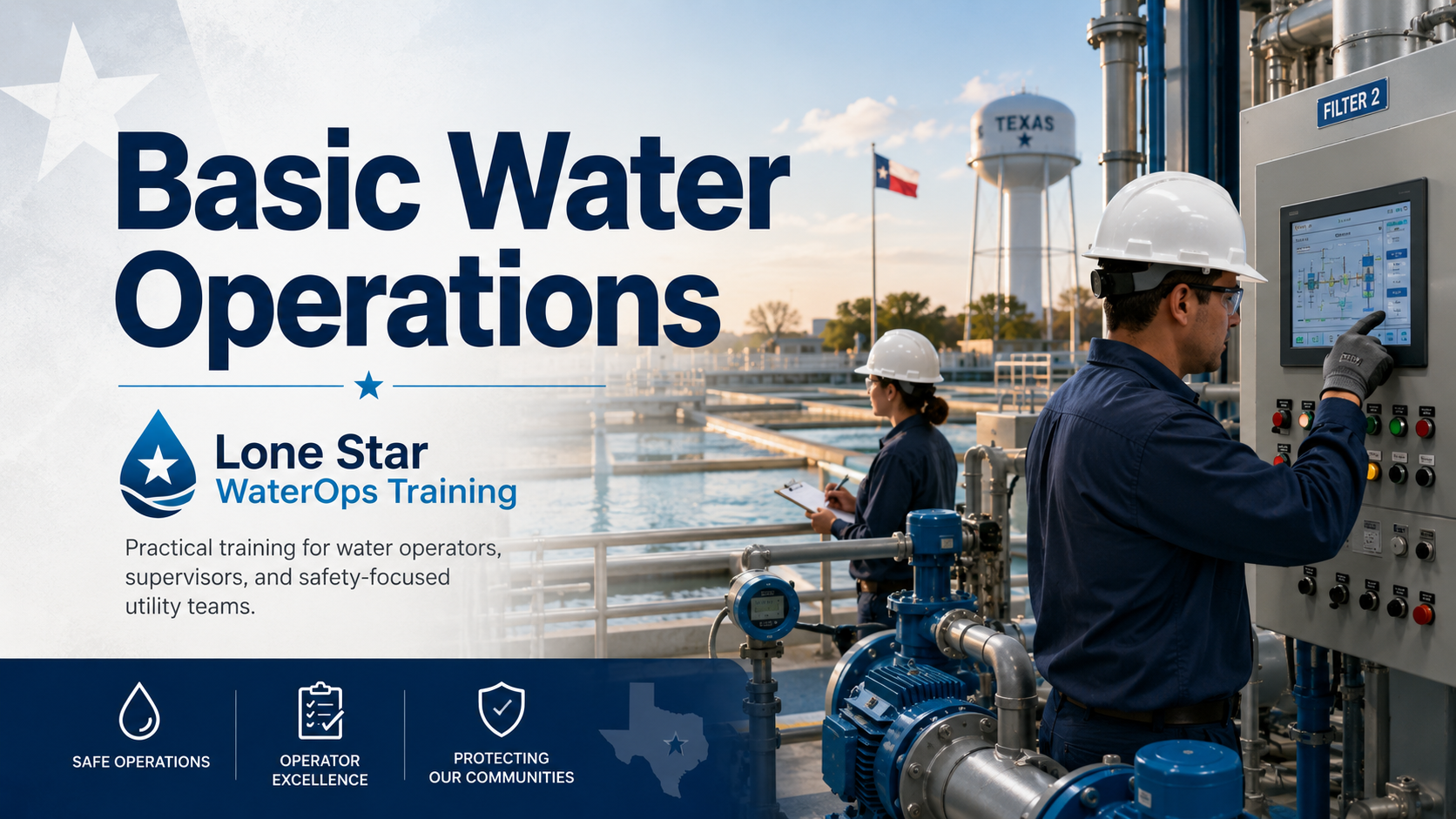
This course introduces the core duties of a public water system operator. Students learn the basics of water sources, treatment, storage, distribution, sampling, regulations, safety, and operator responsibilities. It is designed for new operators, entry-level staff, and anyone preparing to build a strong foundation in drinking water operations. 20-Hr
Prerequisites
There are no prerequisites for this course.
Course Completion Requirements
Participants must provide information for all required fields, including their U.S. citizenship/permanent resident status, and meet all attendance and course completion requirements. If this information is not provided, the participant may be considered incomplete and may not receive a certificate of completion.
Participant Must Provide
Simple calculator with square root function.
Photo identification on the first day of class. See the “Policy” page of the websitefor approved forms of identification and additional guidelines.
Course materials, notebook, and writing utensils as directed by the instructor.
Attendance Requirements
Class attendance is an essential part of the education process. Participants are expected to attend all class sessions, activities, discussions, and required exercises. This course requires participants to attend a minimum of 100% of the class hours as a component of successful course completion. During the course, the instructor will review any additional attendance or participation requirements.
Recommended Prior Training Courses or Knowledge
Prior water utility experience is helpful but not required. This course is recommended for entry-level water operators, utility employees, and individuals preparing to begin the TCEQ water operator licensing pathway.
Upon Successful Completion, Participants Will Be Able To
Explain the basic responsibilities of a public water system operator.
Identify major components of water treatment and distribution systems.
Describe basic water quality, disinfection, safety, and regulatory concepts.
Recognize common operational terms, equipment, and procedures used in drinking water operations.
Apply basic operator knowledge to support safe and compliant utility operations.
This course introduces the core duties of a public water system operator. Students learn the basics of water sources, treatment, storage, distribution, sampling, regulations, safety, and operator responsibilities. It is designed for new operators, entry-level staff, and anyone preparing to build a strong foundation in drinking water operations. 20-Hr Course
Prerequisites
There are no prerequisites for this course.
Course Completion Requirements
Participants must provide information for all required fields, including their U.S. citizenship/permanent resident status, and meet all attendance and course completion requirements. If this information is not provided, the participant may be considered incomplete and may not receive a certificate of completion.
Participant Must Provide
Simple calculator with square root function.
Photo identification on the first day of class. See the “Policy” page of the website for approved forms of identification and additional guidelines.
Course materials, notebook, and writing utensils as directed by the instructor.
Attendance Requirements
Class attendance is an essential part of the education process. Participants are expected to attend all class sessions, activities, discussions, and required exercises. This course requires participants to attend a minimum of 100% of the class hours as a component of successful course completion. During the course, the instructor will review any additional attendance or participation requirements.
Recommended Prior Training Courses or Knowledge
Prior water utility experience is helpful but not required. This course is recommended for entry-level water operators, utility employees, and individuals preparing to begin the TCEQ water operator licensing pathway.
Upon Successful Completion, Participants Will Be Able To
Explain the basic responsibilities of a public water system operator.
Identify major components of water treatment and distribution systems.
Describe basic water quality, disinfection, safety, and regulatory concepts.
Recognize common operational terms, equipment, and procedures used in drinking water operations.
Apply basic operator knowledge to support safe and compliant utility operations.
This course introduces the core duties of a public water system operator. Students learn the basics of water sources, treatment, storage, distribution, sampling, regulations, safety, and operator responsibilities. It is designed for new operators, entry-level staff, and anyone preparing to build a strong foundation in drinking water operations. 20-Hr Course
Prerequisites
There are no prerequisites for this course.
Course Completion Requirements
Participants must provide information for all required fields, including their U.S. citizenship/permanent resident status, and meet all attendance and course completion requirements. If this information is not provided, the participant may be considered incomplete and may not receive a certificate of completion.
Participant Must Provide
Simple calculator with square root function.
Photo identification on the first day of class. See the “Policy” page of the website for approved forms of identification and additional guidelines.
Course materials, notebook, and writing utensils as directed by the instructor.
Attendance Requirements
Class attendance is an essential part of the education process. Participants are expected to attend all class sessions, activities, discussions, and required exercises. This course requires participants to attend a minimum of 100% of the class hours as a component of successful course completion. During the course, the instructor will review any additional attendance or participation requirements.
Recommended Prior Training Courses or Knowledge
Prior water utility experience is helpful but not required. This course is recommended for entry-level water operators, utility employees, and individuals preparing to begin the TCEQ water operator licensing pathway.
Upon Successful Completion, Participants Will Be Able To
Explain the basic responsibilities of a public water system operator.
Identify major components of water treatment and distribution systems.
Describe basic water quality, disinfection, safety, and regulatory concepts.
Recognize common operational terms, equipment, and procedures used in drinking water operations.
Apply basic operator knowledge to support safe and compliant utility operations.
This course introduces the core duties of a public water system operator. Students learn the basics of water sources, treatment, storage, distribution, sampling, regulations, safety, and operator responsibilities. It is designed for new operators, entry-level staff, and anyone preparing to build a strong foundation in drinking water operations. 20-Hr Course
Prerequisites
There are no prerequisites for this course.
Course Completion Requirements
Participants must provide information for all required fields, including their U.S. citizenship/permanent resident status, and meet all attendance and course completion requirements. If this information is not provided, the participant may be considered incomplete and may not receive a certificate of completion.
Participant Must Provide
Simple calculator with square root function.
Photo identification on the first day of class. See the “Policy” page of the website for approved forms of identification and additional guidelines.
Course materials, notebook, and writing utensils as directed by the instructor.
Attendance Requirements
Class attendance is an essential part of the education process. Participants are expected to attend all class sessions, activities, discussions, and required exercises. This course requires participants to attend a minimum of 100% of the class hours as a component of successful course completion. During the course, the instructor will review any additional attendance or participation requirements.
Recommended Prior Training Courses or Knowledge
Prior water utility experience is helpful but not required. This course is recommended for entry-level water operators, utility employees, and individuals preparing to begin the TCEQ water operator licensing pathway.
Upon Successful Completion, Participants Will Be Able To
Explain the basic responsibilities of a public water system operator.
Identify major components of water treatment and distribution systems.
Describe basic water quality, disinfection, safety, and regulatory concepts.
Recognize common operational terms, equipment, and procedures used in drinking water operations.
Apply basic operator knowledge to support safe and compliant utility operations.
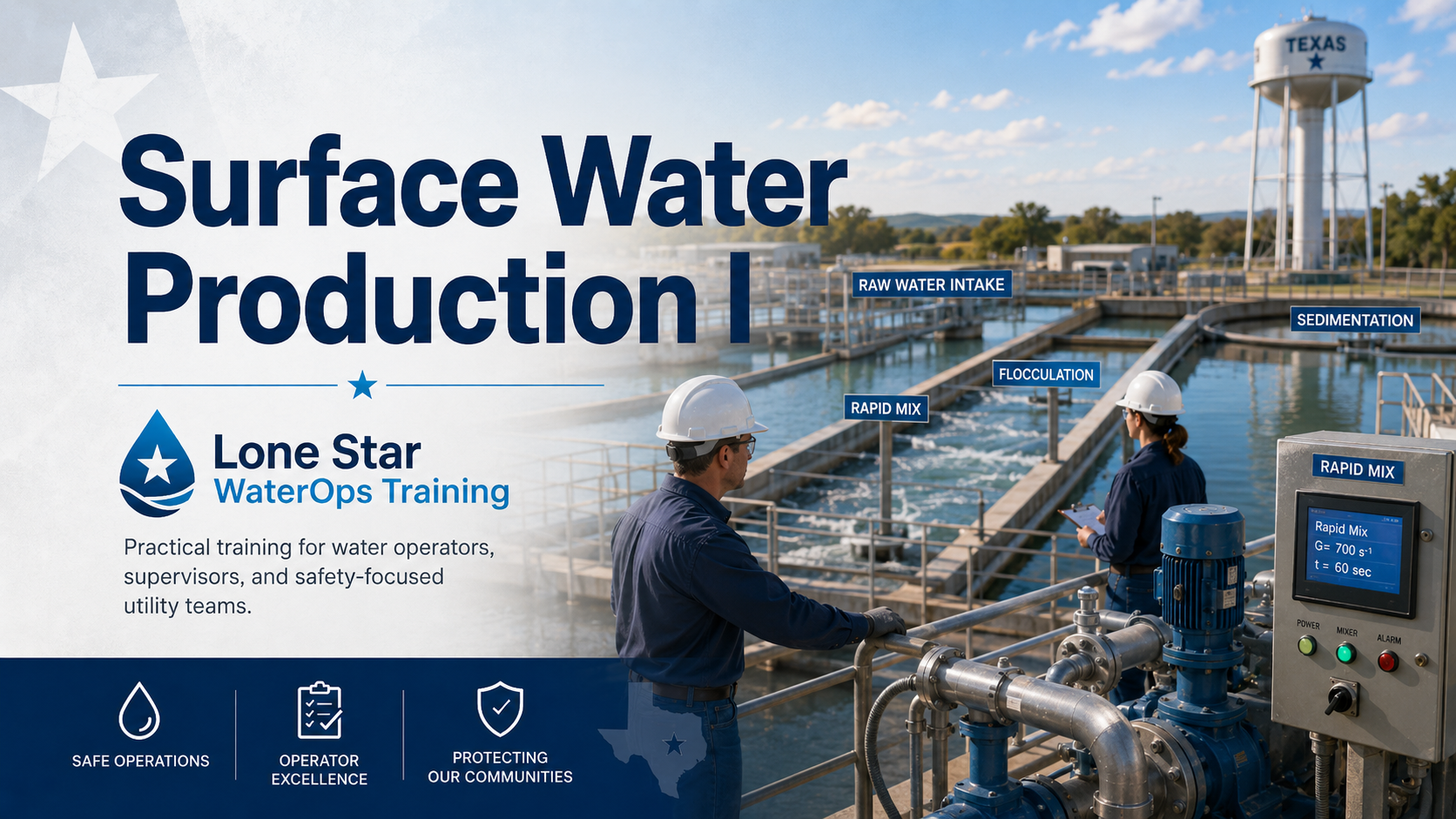
This course introduces the core duties of a public water system operator. Students learn the basics of water sources, treatment, storage, distribution, sampling, regulations, safety, and operator responsibilities. It is designed for new operators, entry-level staff, and anyone preparing to build a strong foundation in drinking water operations. 20-Hr Course
Prerequisites
There are no prerequisites for this course.
Course Completion Requirements
Participants must provide information for all required fields, including their U.S. citizenship/permanent resident status, and meet all attendance and course completion requirements. If this information is not provided, the participant may be considered incomplete and may not receive a certificate of completion.
Participant Must Provide
Simple calculator with square root function.
Photo identification on the first day of class. See the “Policy” page of the website for approved forms of identification and additional guidelines.
Course materials, notebook, and writing utensils as directed by the instructor.
Attendance Requirements
Class attendance is an essential part of the education process. Participants are expected to attend all class sessions, activities, discussions, and required exercises. This course requires participants to attend a minimum of 100% of the class hours as a component of successful course completion. During the course, the instructor will review any additional attendance or participation requirements.
Recommended Prior Training Courses or Knowledge
Prior completion of Basic Water Operations is recommended but not required. Participants should have a basic understanding of water treatment plant operations, operator safety, water quality, and public water system responsibilities.
Upon Successful Completion, Participants Will Be Able To
Describe surface water sources and raw water quality concerns.
Explain conventional surface water treatment processes, including coagulation, flocculation, sedimentation, filtration, and disinfection.
Identify basic chemical feed, jar testing, and process control considerations.
Recognize the importance of turbidity control, pathogen removal, and treatment barriers.
Apply basic operational knowledge to support safe and compliant surface water treatment.
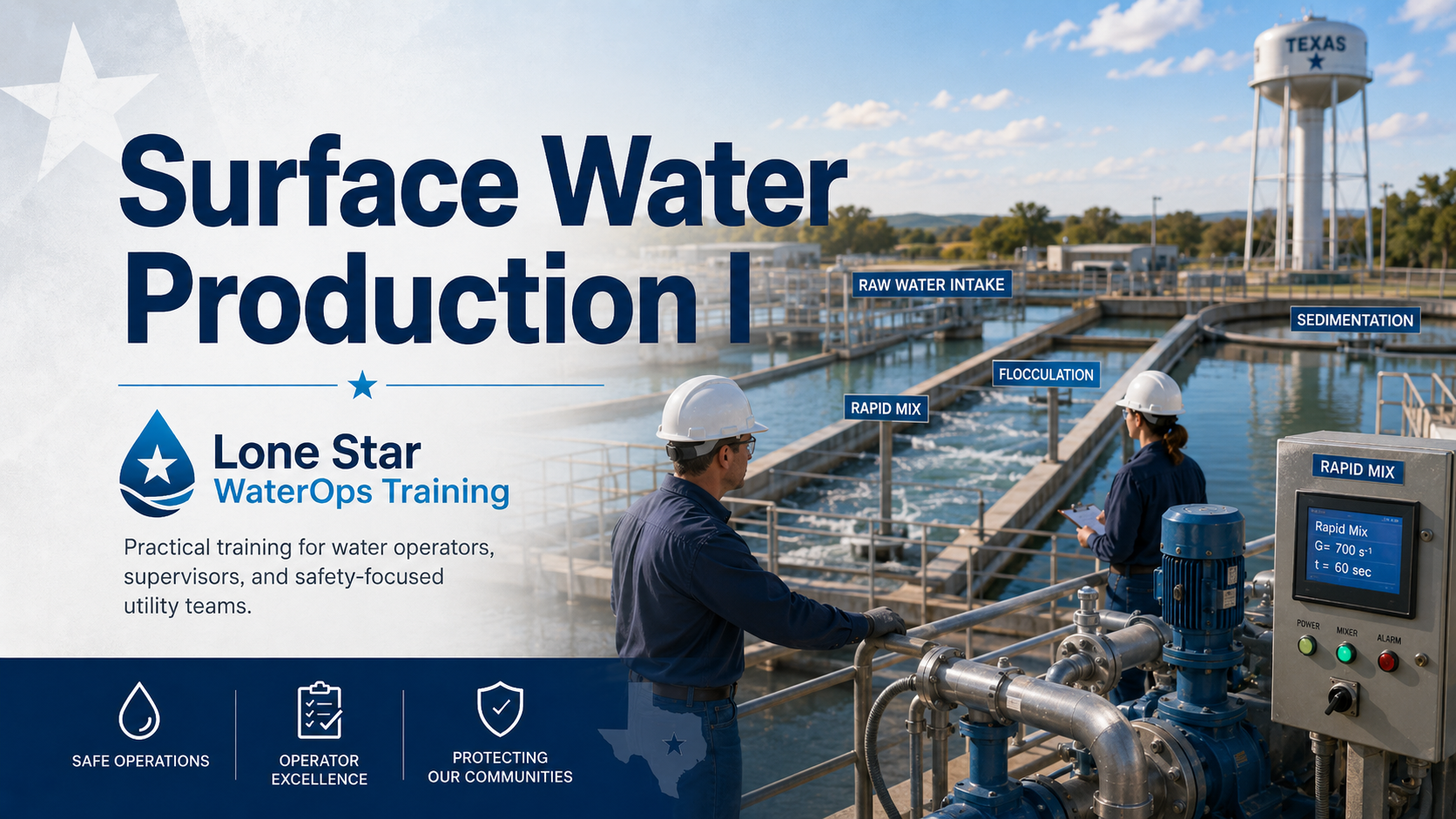
This course covers the first major steps in treating surface water. Topics include raw water intake, coagulation, rapid mixing, flocculation, sedimentation, turbidity control, process monitoring, and basic treatment chemistry. It is built for operators working at or preparing for surface water treatment plants. 20-Hr Course
Prerequisites
There are no prerequisites for this course.
Course Completion Requirements
Participants must provide information for all required fields, including their U.S. citizenship/permanent resident status, and meet all attendance and course completion requirements. If this information is not provided, the participant may be considered incomplete and may not receive a certificate of completion.
Participant Must Provide
Simple calculator with square root function.
Photo identification on the first day of class. See the “Policy” page of the website for approved forms of identification and additional guidelines.
Course materials, notebook, and writing utensils as directed by the instructor.
Attendance Requirements
Class attendance is an essential part of the education process. Participants are expected to attend all class sessions, activities, discussions, and required exercises. This course requires participants to attend a minimum of 100% of the class hours as a component of successful course completion. During the course, the instructor will review any additional attendance or participation requirements.
Recommended Prior Training Courses or Knowledge
Prior completion of Basic Water Operations is recommended but not required. Participants should have a basic understanding of water treatment plant operations, operator safety, water quality, and public water system responsibilities.
Upon Successful Completion, Participants Will Be Able To
Describe surface water sources and raw water quality concerns.
Explain conventional surface water treatment processes, including coagulation, flocculation, sedimentation, filtration, and disinfection.
Identify basic chemical feed, jar testing, and process control considerations.
Recognize the importance of turbidity control, pathogen removal, and treatment barriers.
Apply basic operational knowledge to support safe and compliant surface water treatment.
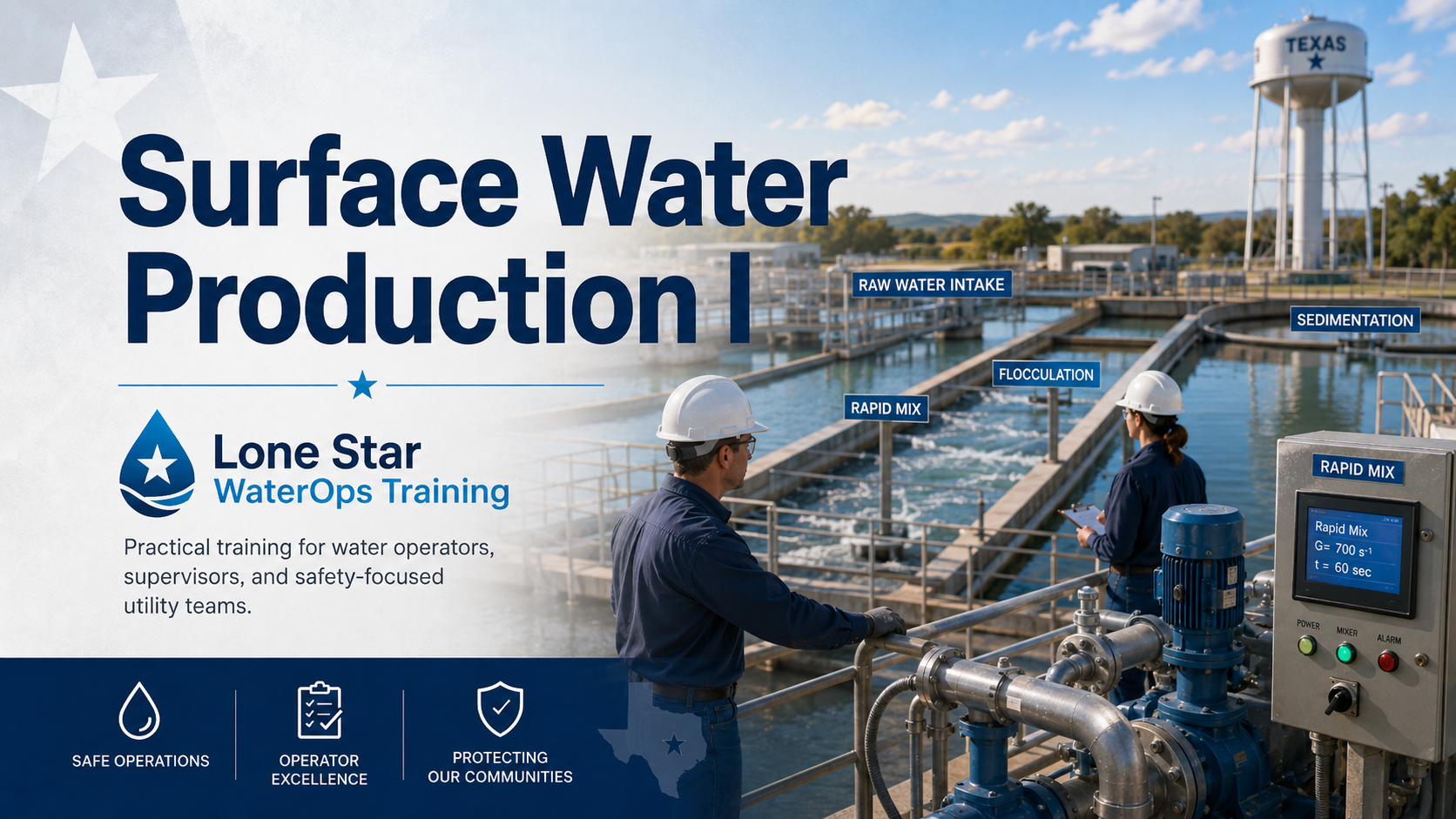
This course covers the first major steps in treating surface water. Topics include raw water intake, coagulation, rapid mixing, flocculation, sedimentation, turbidity control, process monitoring, and basic treatment chemistry. It is built for operators working at or preparing for surface water treatment plants. 20-Hr Course
Prerequisites
There are no prerequisites for this course.
Course Completion Requirements
Participants must provide information for all required fields, including their U.S. citizenship/permanent resident status, and meet all attendance and course completion requirements. If this information is not provided, the participant may be considered incomplete and may not receive a certificate of completion.
Participant Must Provide
Simple calculator with square root function.
Photo identification on the first day of class. See the “Policy” page of the website for approved forms of identification and additional guidelines.
Course materials, notebook, and writing utensils as directed by the instructor.
Attendance Requirements
Class attendance is an essential part of the education process. Participants are expected to attend all class sessions, activities, discussions, and required exercises. This course requires participants to attend a minimum of 100% of the class hours as a component of successful course completion. During the course, the instructor will review any additional attendance or participation requirements.
Recommended Prior Training Courses or Knowledge
Prior completion of Basic Water Operations is recommended but not required. Participants should have a basic understanding of water treatment plant operations, operator safety, water quality, and public water system responsibilities.
Upon Successful Completion, Participants Will Be Able To
Describe surface water sources and raw water quality concerns.
Explain conventional surface water treatment processes, including coagulation, flocculation, sedimentation, filtration, and disinfection.
Identify basic chemical feed, jar testing, and process control considerations.
Recognize the importance of turbidity control, pathogen removal, and treatment barriers.
Apply basic operational knowledge to support safe and compliant surface water treatment.
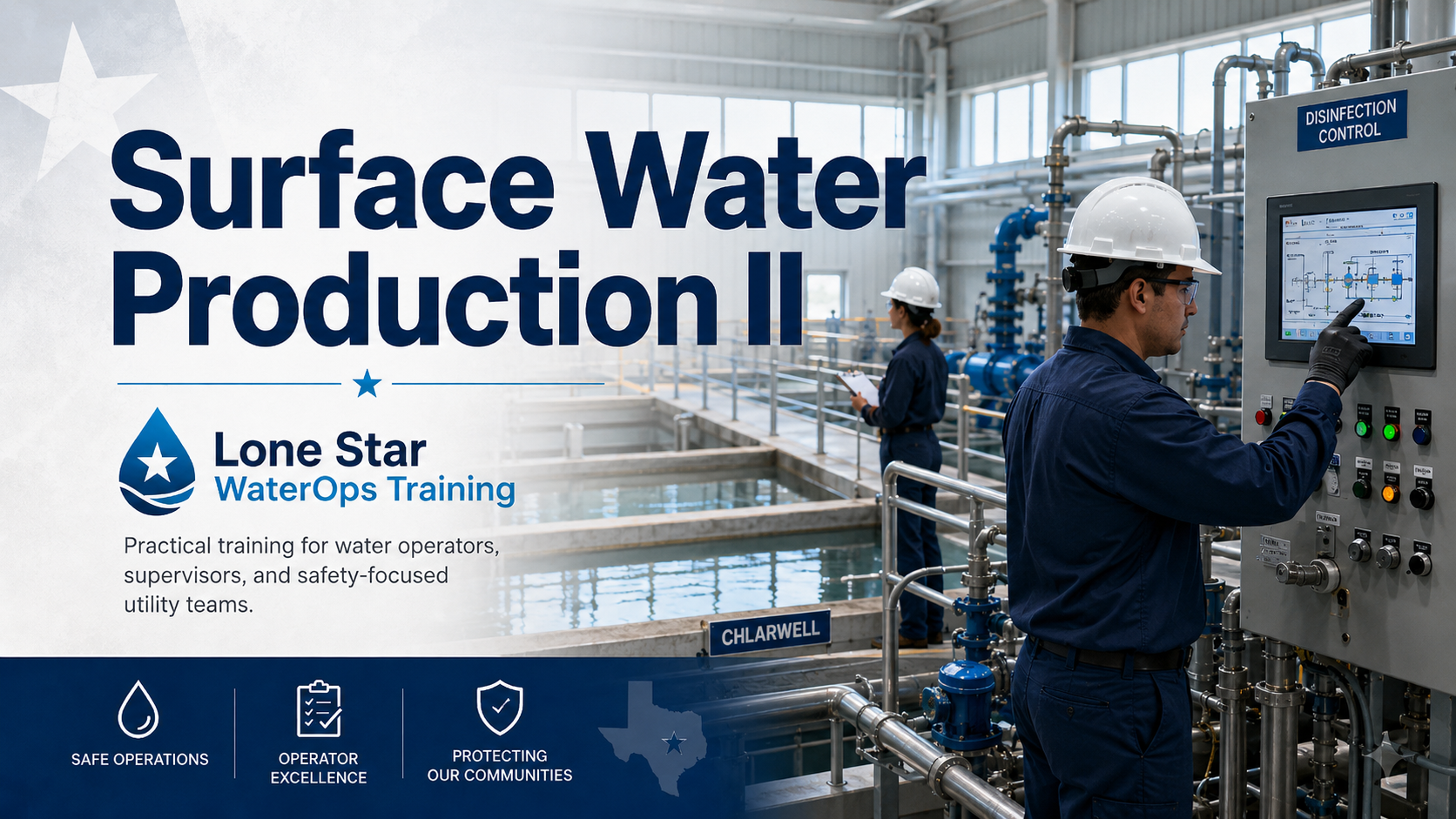
This course builds on Surface Water Production I and focuses on advanced surface water treatment processes. Topics include filtration, disinfection, clearwell operation, chemical feed control, finished water quality, regulatory monitoring, troubleshooting, and plant performance. It helps operators understand how each process affects compliance and public health protection. 20-Hr Course
Prerequisites
There are no prerequisites for this course.
Course Completion Requirements
Participants must provide information for all required fields, including their U.S. citizenship/permanent resident status, and meet all attendance and course completion requirements. If this information is not provided, the participant may be considered incomplete and may not receive a certificate of completion.
Participant Must Provide
Simple calculator with square root function.
Photo identification on the first day of class. See the “Policy” page of the website for approved forms of identification and additional guidelines.
Course materials, notebook, and writing utensils as directed by the instructor.
Attendance Requirements
Class attendance is an essential part of the education process. Participants are expected to attend all class sessions, activities, discussions, and required exercises. This course requires participants to attend a minimum of 100% of the class hours as a component of successful course completion. During the course, the instructor will review any additional attendance or participation requirements.
Recommended Prior Training Courses or Knowledge
Prior completion of Surface Water Production I is recommended but not required. Participants should have working knowledge of conventional treatment processes, filtration, disinfection, turbidity control, and plant process monitoring.
Upon Successful Completion, Participants Will Be Able To
Evaluate advanced surface water treatment process control issues.
Explain filtration performance, filter monitoring, backwashing, and finished water quality considerations.
Assess disinfection practices, residual control, and regulatory compliance concerns.
Identify operational problems related to chemical feed, turbidity, taste and odor, and treatment optimization.
Apply process control strategies to improve surface water treatment reliability and performance.
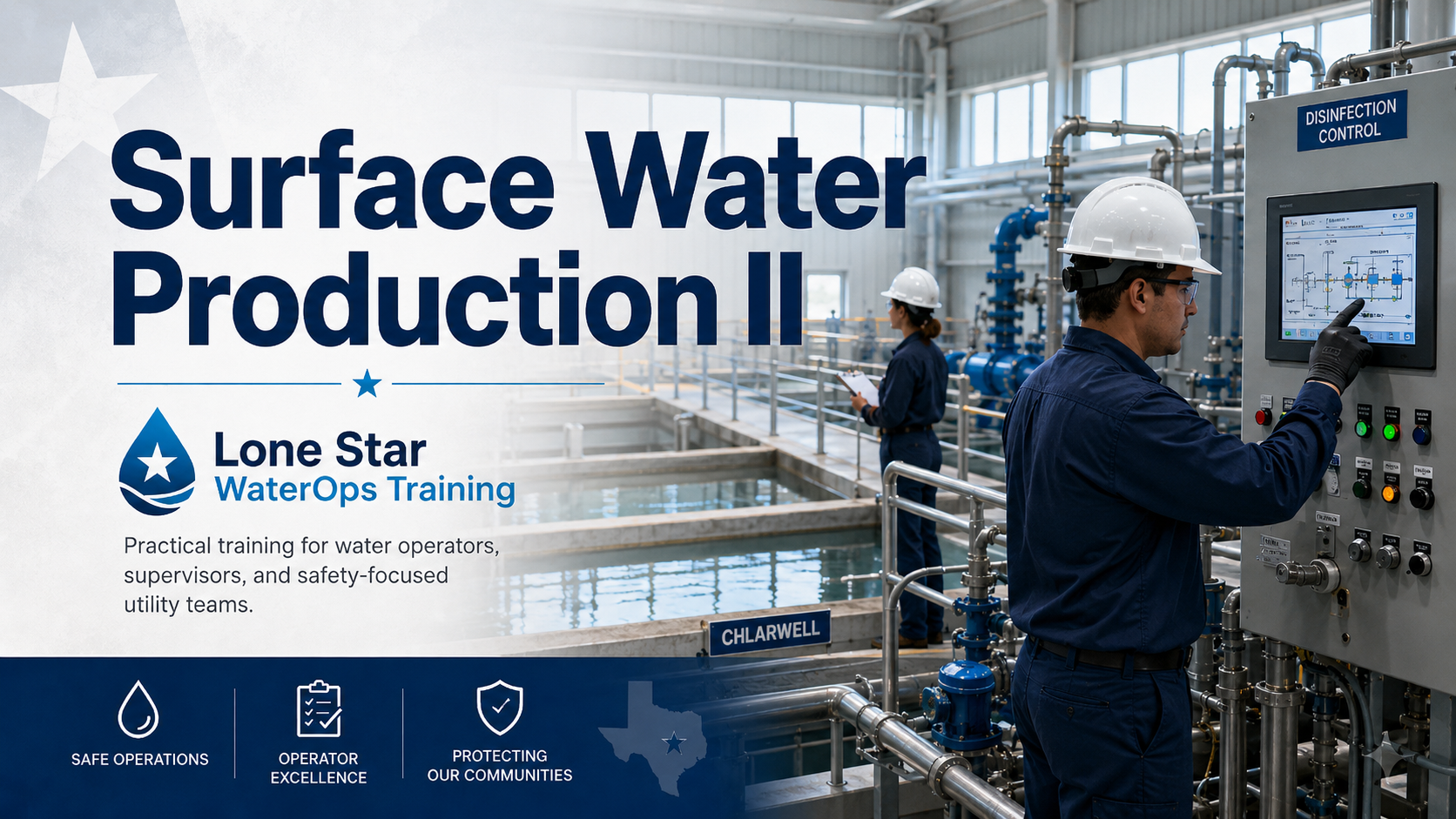
This course builds on Surface Water Production I and focuses on advanced surface water treatment processes. Topics include filtration, disinfection, clearwell operation, chemical feed control, finished water quality, regulatory monitoring, troubleshooting, and plant performance. It helps operators understand how each process affects compliance and public health protection. 20-Hr Course
Prerequisites
There are no prerequisites for this course.
Course Completion Requirements
Participants must provide information for all required fields, including their U.S. citizenship/permanent resident status, and meet all attendance and course completion requirements. If this information is not provided, the participant may be considered incomplete and may not receive a certificate of completion.
Participant Must Provide
Simple calculator with square root function.
Photo identification on the first day of class. See the “Policy” page of the website for approved forms of identification and additional guidelines.
Course materials, notebook, and writing utensils as directed by the instructor.
Attendance Requirements
Class attendance is an essential part of the education process. Participants are expected to attend all class sessions, activities, discussions, and required exercises. This course requires participants to attend a minimum of 100% of the class hours as a component of successful course completion. During the course, the instructor will review any additional attendance or participation requirements.
Recommended Prior Training Courses or Knowledge
Prior completion of Surface Water Production I is recommended but not required. Participants should have working knowledge of conventional treatment processes, filtration, disinfection, turbidity control, and plant process monitoring.
Upon Successful Completion, Participants Will Be Able To
Evaluate advanced surface water treatment process control issues.
Explain filtration performance, filter monitoring, backwashing, and finished water quality considerations.
Assess disinfection practices, residual control, and regulatory compliance concerns.
Identify operational problems related to chemical feed, turbidity, taste and odor, and treatment optimization.
Apply process control strategies to improve surface water treatment reliability and performance.
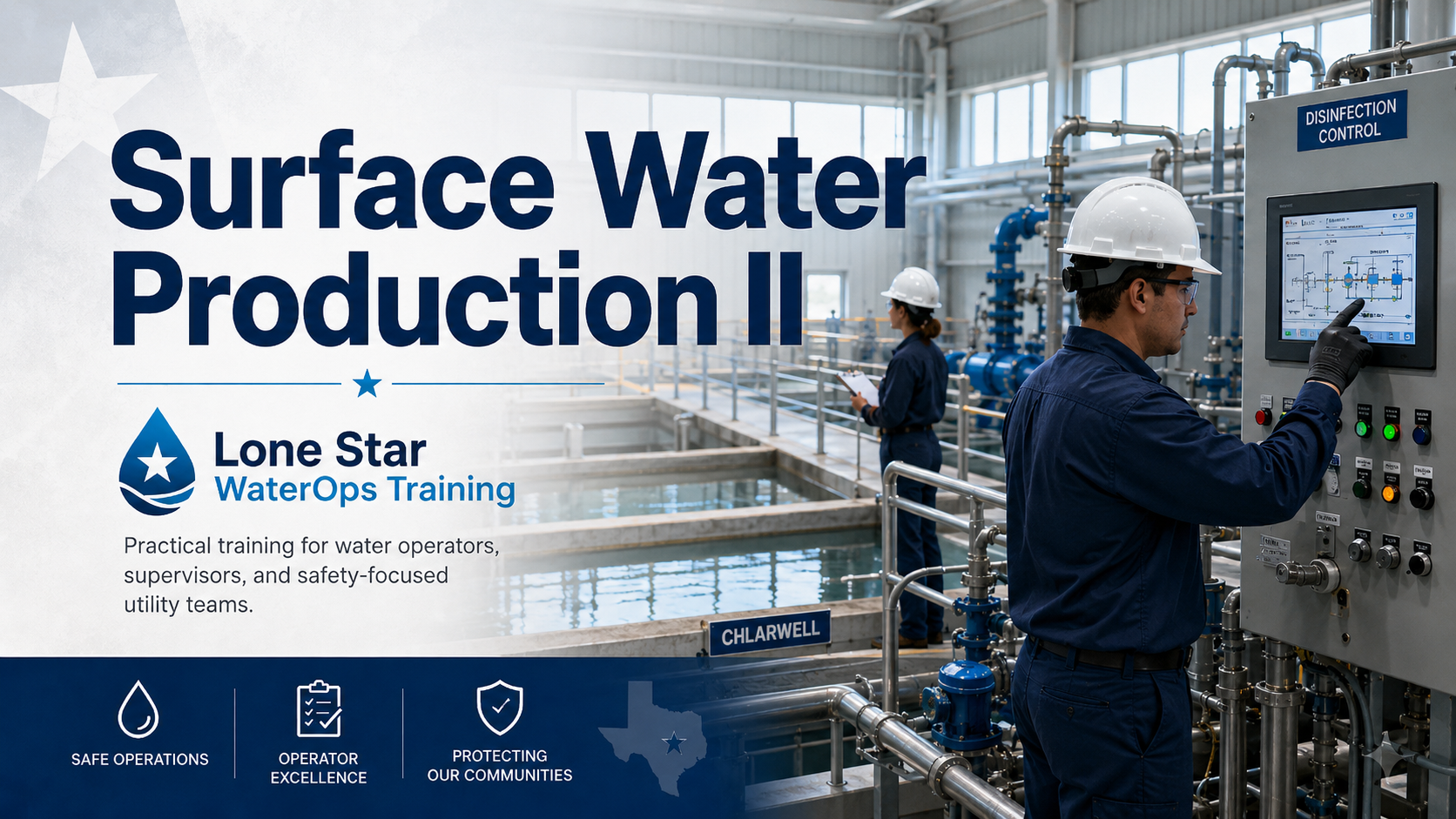
This course builds on Surface Water Production I and focuses on advanced surface water treatment processes. Topics include filtration, disinfection, clearwell operation, chemical feed control, finished water quality, regulatory monitoring, troubleshooting, and plant performance. It helps operators understand how each process affects compliance and public health protection. 20-Hr Course
Prerequisites
There are no prerequisites for this course.
Course Completion Requirements
Participants must provide information for all required fields, including their U.S. citizenship/permanent resident status, and meet all attendance and course completion requirements. If this information is not provided, the participant may be considered incomplete and may not receive a certificate of completion.
Participant Must Provide
Simple calculator with square root function.
Photo identification on the first day of class. See the “Policy” page of the website for approved forms of identification and additional guidelines.
Course materials, notebook, and writing utensils as directed by the instructor.
Attendance Requirements
Class attendance is an essential part of the education process. Participants are expected to attend all class sessions, activities, discussions, and required exercises. This course requires participants to attend a minimum of 100% of the class hours as a component of successful course completion. During the course, the instructor will review any additional attendance or participation requirements.
Recommended Prior Training Courses or Knowledge
Prior completion of Surface Water Production I is recommended but not required. Participants should have working knowledge of conventional treatment processes, filtration, disinfection, turbidity control, and plant process monitoring.
Upon Successful Completion, Participants Will Be Able To
Evaluate advanced surface water treatment process control issues.
Explain filtration performance, filter monitoring, backwashing, and finished water quality considerations.
Assess disinfection practices, residual control, and regulatory compliance concerns.
Identify operational problems related to chemical feed, turbidity, taste and odor, and treatment optimization.
Apply process control strategies to improve surface water treatment reliability and performance.
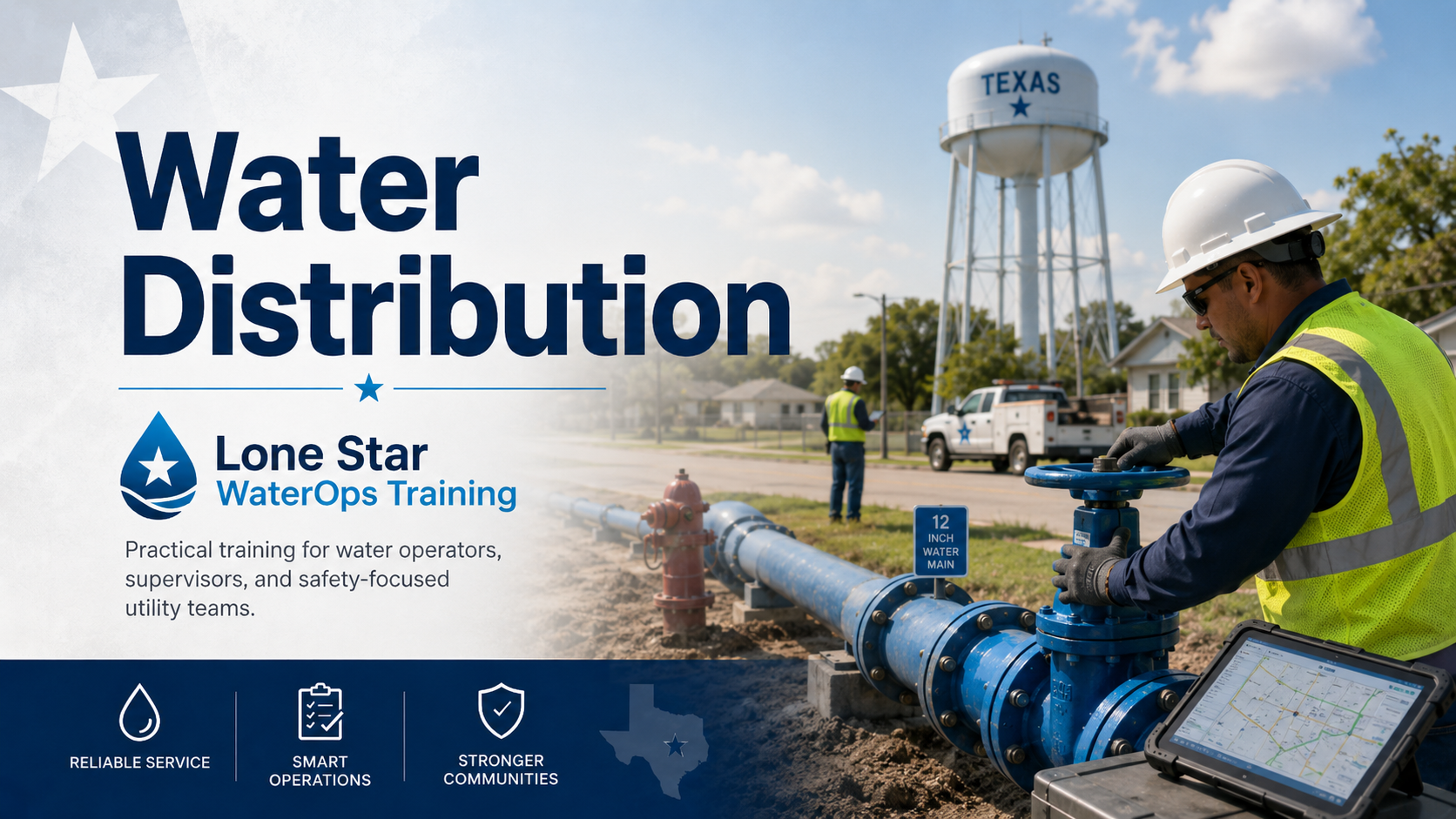
This course focuses on moving safe drinking water from the plant or well site to the customer. Topics include water mains, valves, hydrants, storage tanks, pressure zones, pumps, flushing, line repairs, cross-connection concerns, disinfectant residuals, and distribution system water quality. It is a key course for both plant and field operators. 20-Hr Course
Prerequisites
There are no prerequisites for this course.
Course Completion Requirements
Participants must provide information for all required fields, including their U.S. citizenship/permanent resident status, and meet all attendance and course completion requirements. If this information is not provided, the participant may be considered incomplete and may not receive a certificate of completion.
Participant Must Provide
Simple calculator with square root function.
Photo identification on the first day of class. See the “Policy” page of the website for approved forms of identification and additional guidelines.
Course materials, notebook, and writing utensils as directed by the instructor.
Attendance Requirements
Class attendance is an essential part of the education process. Participants are expected to attend all class sessions, activities, discussions, and required exercises. This course requires participants to attend a minimum of 100% of the class hours as a component of successful course completion. During the course, the instructor will review any additional attendance or participation requirements.
Recommended Prior Training Courses or Knowledge
Prior completion of Basic Water Operations or equivalent water utility experience is recommended but not required. Participants should have basic familiarity with drinking water systems, disinfection, customer service, and utility field operations.
Upon Successful Completion, Participants Will Be Able To
Identify major components of a water distribution system, including mains, valves, hydrants, meters, storage tanks, and service connections.
Explain distribution system operation, maintenance, flushing, pressure control, and water quality protection.
Describe cross-connection control, backflow prevention, and contamination prevention concepts.
Recognize common distribution system problems, including leaks, pressure loss, main breaks, and water quality complaints.
Apply safe work practices and regulatory awareness to distribution system operations.
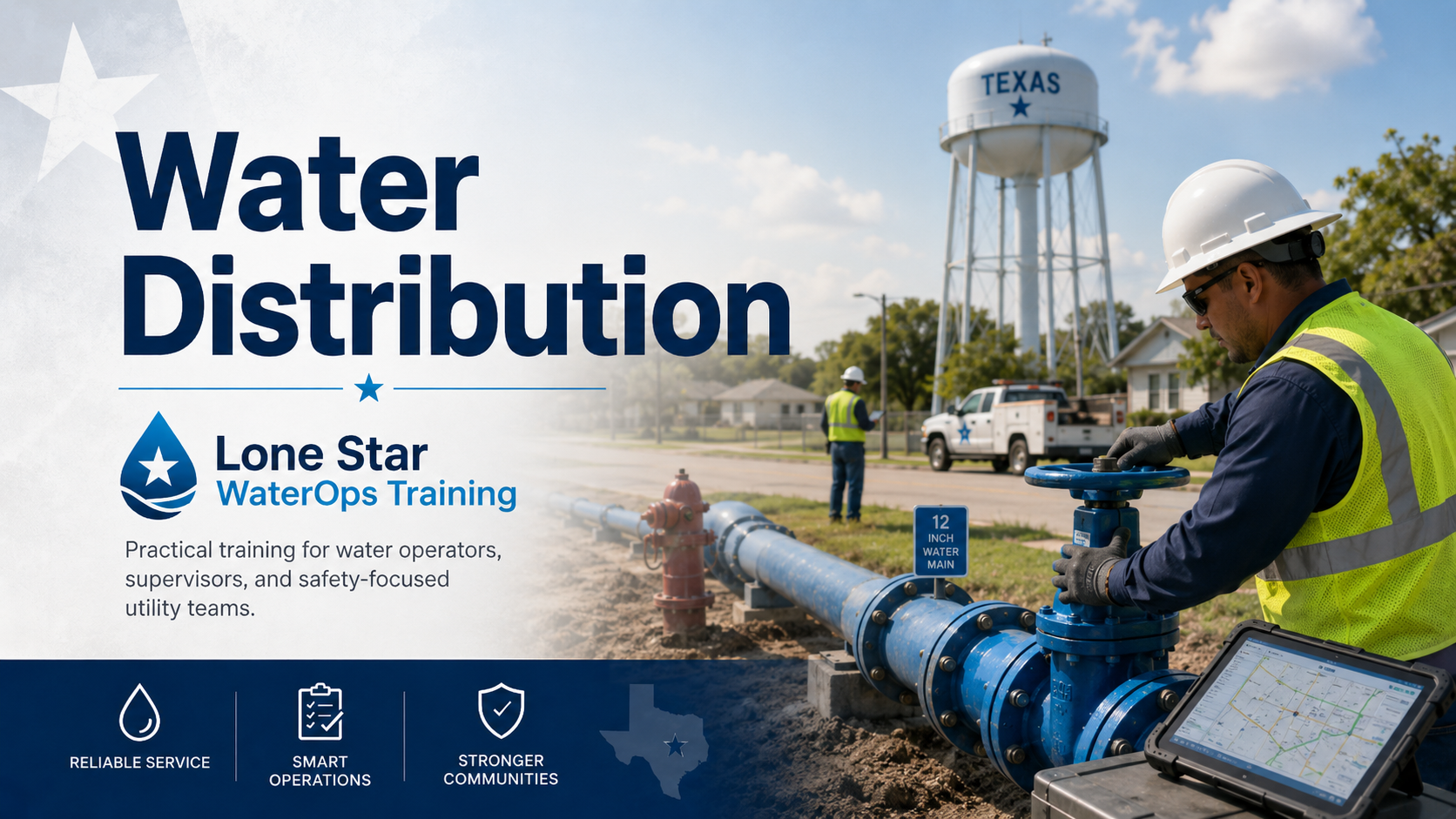
This course focuses on moving safe drinking water from the plant or well site to the customer. Topics include water mains, valves, hydrants, storage tanks, pressure zones, pumps, flushing, line repairs, cross-connection concerns, disinfectant residuals, and distribution system water quality. It is a key course for both plant and field operators. 20-Hr Course
Prerequisites
There are no prerequisites for this course.
Course Completion Requirements
Participants must provide information for all required fields, including their U.S. citizenship/permanent resident status, and meet all attendance and course completion requirements. If this information is not provided, the participant may be considered incomplete and may not receive a certificate of completion.
Participant Must Provide
Simple calculator with square root function.
Photo identification on the first day of class. See the “Policy” page of the website for approved forms of identification and additional guidelines.
Course materials, notebook, and writing utensils as directed by the instructor.
Attendance Requirements
Class attendance is an essential part of the education process. Participants are expected to attend all class sessions, activities, discussions, and required exercises. This course requires participants to attend a minimum of 100% of the class hours as a component of successful course completion. During the course, the instructor will review any additional attendance or participation requirements.
Recommended Prior Training Courses or Knowledge
Prior completion of Basic Water Operations or equivalent water utility experience is recommended but not required. Participants should have basic familiarity with drinking water systems, disinfection, customer service, and utility field operations.
Upon Successful Completion, Participants Will Be Able To
Identify major components of a water distribution system, including mains, valves, hydrants, meters, storage tanks, and service connections.
Explain distribution system operation, maintenance, flushing, pressure control, and water quality protection.
Describe cross-connection control, backflow prevention, and contamination prevention concepts.
Recognize common distribution system problems, including leaks, pressure loss, main breaks, and water quality complaints.
Apply safe work practices and regulatory awareness to distribution system operations.
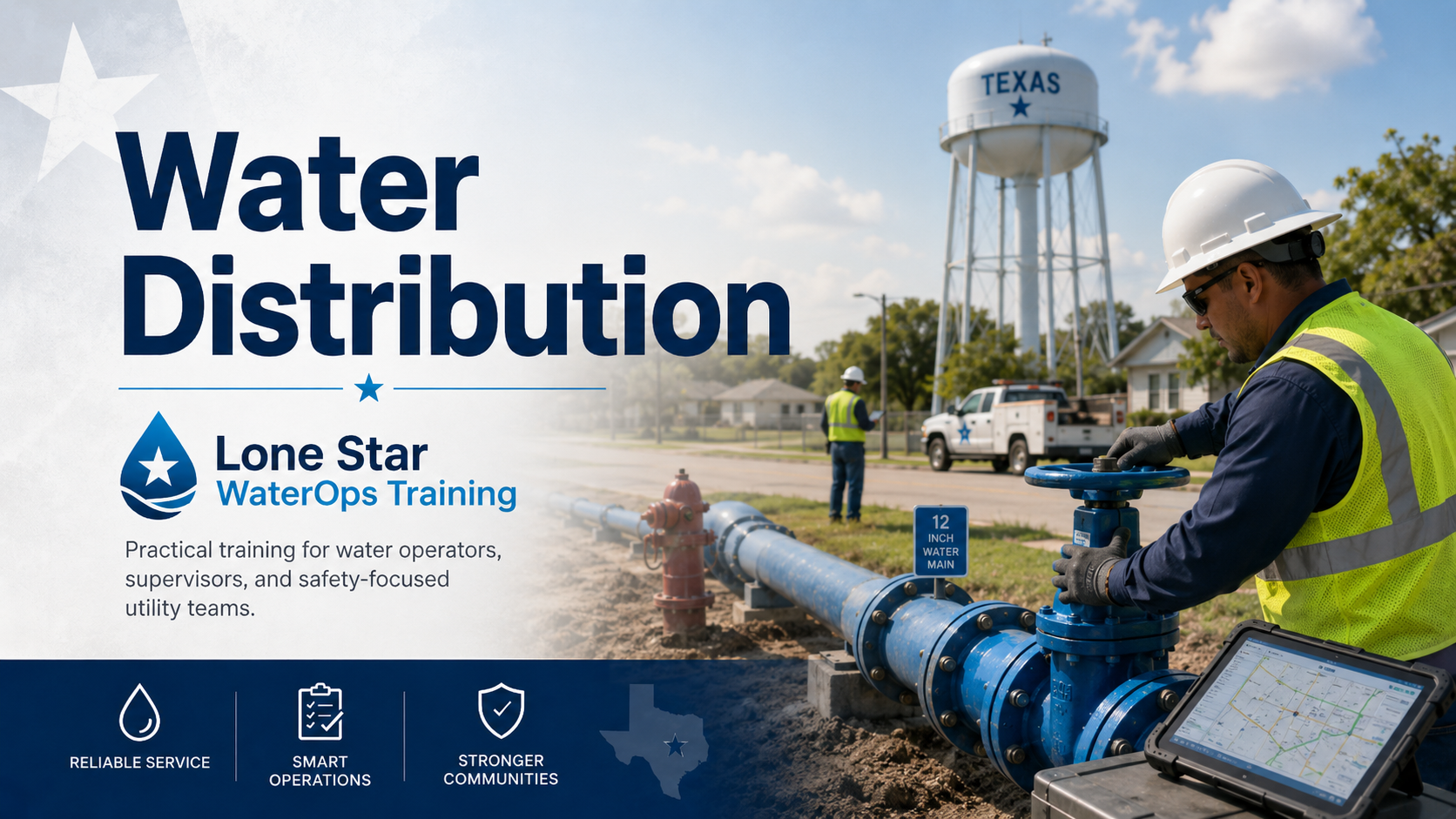
This course focuses on moving safe drinking water from the plant or well site to the customer. Topics include water mains, valves, hydrants, storage tanks, pressure zones, pumps, flushing, line repairs, cross-connection concerns, disinfectant residuals, and distribution system water quality. It is a key course for both plant and field operators. 20-Hr Course
Prerequisites
There are no prerequisites for this course.
Course Completion Requirements
Participants must provide information for all required fields, including their U.S. citizenship/permanent resident status, and meet all attendance and course completion requirements. If this information is not provided, the participant may be considered incomplete and may not receive a certificate of completion.
Participant Must Provide
Simple calculator with square root function.
Photo identification on the first day of class. See the “Policy” page of the website for approved forms of identification and additional guidelines.
Course materials, notebook, and writing utensils as directed by the instructor.
Attendance Requirements
Class attendance is an essential part of the education process. Participants are expected to attend all class sessions, activities, discussions, and required exercises. This course requires participants to attend a minimum of 100% of the class hours as a component of successful course completion. During the course, the instructor will review any additional attendance or participation requirements.
Recommended Prior Training Courses or Knowledge
Prior completion of Basic Water Operations or equivalent water utility experience is recommended but not required. Participants should have basic familiarity with drinking water systems, disinfection, customer service, and utility field operations.
Upon Successful Completion, Participants Will Be Able To
Identify major components of a water distribution system, including mains, valves, hydrants, meters, storage tanks, and service connections.
Explain distribution system operation, maintenance, flushing, pressure control, and water quality protection.
Describe cross-connection control, backflow prevention, and contamination prevention concepts.
Recognize common distribution system problems, including leaks, pressure loss, main breaks, and water quality complaints.
Apply safe work practices and regulatory awareness to distribution system operations.
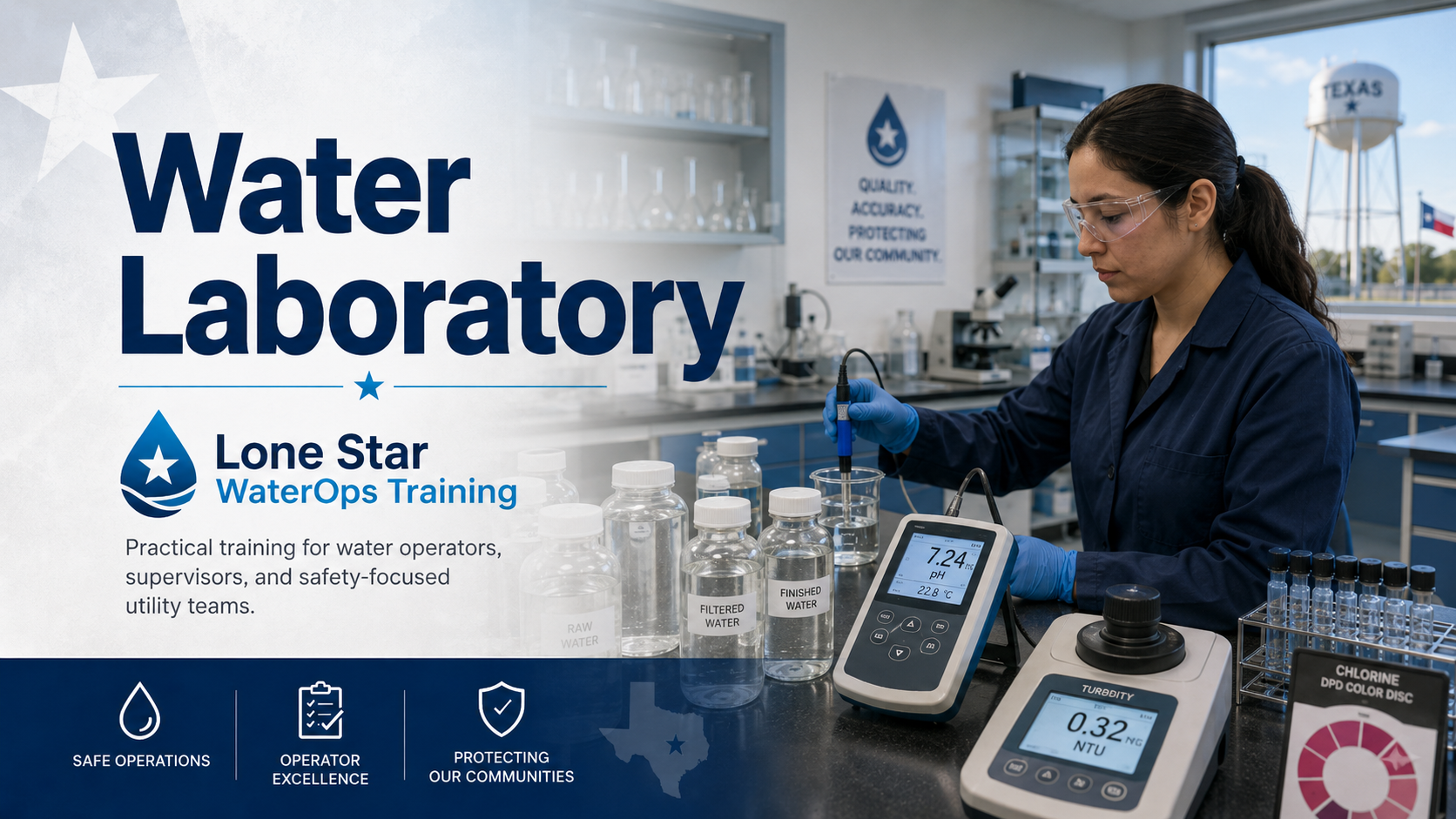
This course introduces operators to common drinking water laboratory tests and proper sampling practices. Topics include pH, turbidity, chlorine residual, bacteriological sampling, sample preservation, calibration, quality control, record keeping, and interpreting lab results. The goal is to help operators make better process decisions using accurate data. 20-Hr Course
Prerequisites
There are no prerequisites for this course.
Course Completion Requirements
Participants must provide information for all required fields, including their U.S. citizenship/permanent resident status, and meet all attendance and course completion requirements. If this information is not provided, the participant may be considered incomplete and may not receive a certificate of completion.
Participant Must Provide
Simple calculator with square root function.
Photo identification on the first day of class. See the “Policy” page of the website for approved forms of identification and additional guidelines.
Course materials, notebook, and writing utensils as directed by the instructor.
Attendance Requirements
Class attendance is an essential part of the education process. Participants are expected to attend all class sessions, activities, discussions, and required exercises. This course requires participants to attend a minimum of 100% of the class hours as a component of successful course completion. During the course, the instructor will review any additional attendance or participation requirements.
Recommended Prior Training Courses or Knowledge
Prior completion of Basic Water Operations is recommended but not required. Participants should have a basic understanding of water quality, disinfection, sampling, and public water system operations.
Upon Successful Completion, Participants Will Be Able To
Describe common drinking water laboratory tests and their operational importance.
Explain proper sampling, sample handling, preservation, and documentation practices.
Identify basic laboratory equipment used for pH, turbidity, disinfectant residual, alkalinity, hardness, and other common water quality tests.
Recognize quality assurance, quality control, calibration, and recordkeeping requirements.
Apply laboratory results to support treatment decisions and regulatory compliance.
This course introduces operators to common drinking water laboratory tests and proper sampling practices. Topics include pH, turbidity, chlorine residual, bacteriological sampling, sample preservation, calibration, quality control, record keeping, and interpreting lab results. The goal is to help operators make better process decisions using accurate data. 20-Hr Course
Prerequisites
There are no prerequisites for this course.
Course Completion Requirements
Participants must provide information for all required fields, including their U.S. citizenship/permanent resident status, and meet all attendance and course completion requirements. If this information is not provided, the participant may be considered incomplete and may not receive a certificate of completion.
Participant Must Provide
Simple calculator with square root function.
Photo identification on the first day of class. See the“Policy” page of the website for approved forms of identification and additional guidelines.
Course materials, notebook, and writing utensils as directed by the instructor.
Attendance Requirements
Class attendance is an essential part of the education process. Participants are expected to attend all class sessions, activities, discussions, and required exercises. This course requires participants to attend a minimum of 100% of the class hours as a component of successful course completion. During the course, the instructor will review any additional attendance or participation requirements.
Recommended Prior Training Courses or Knowledge
Prior completion of Basic Water Operations is recommended but not required. Participants should have a basic understanding of water quality, disinfection, sampling, and public water system operations.
Upon Successful Completion, Participants Will Be Able To
Describe common drinking water laboratory tests and their operational importance.
Explain proper sampling, sample handling, preservation, and documentation practices.
Identify basic laboratory equipment used for pH, turbidity, disinfectant residual, alkalinity, hardness, and other common water quality tests.
Recognize quality assurance, quality control, calibration, and recordkeeping requirements.
Apply laboratory results to support treatment decisions and regulatory compliance.
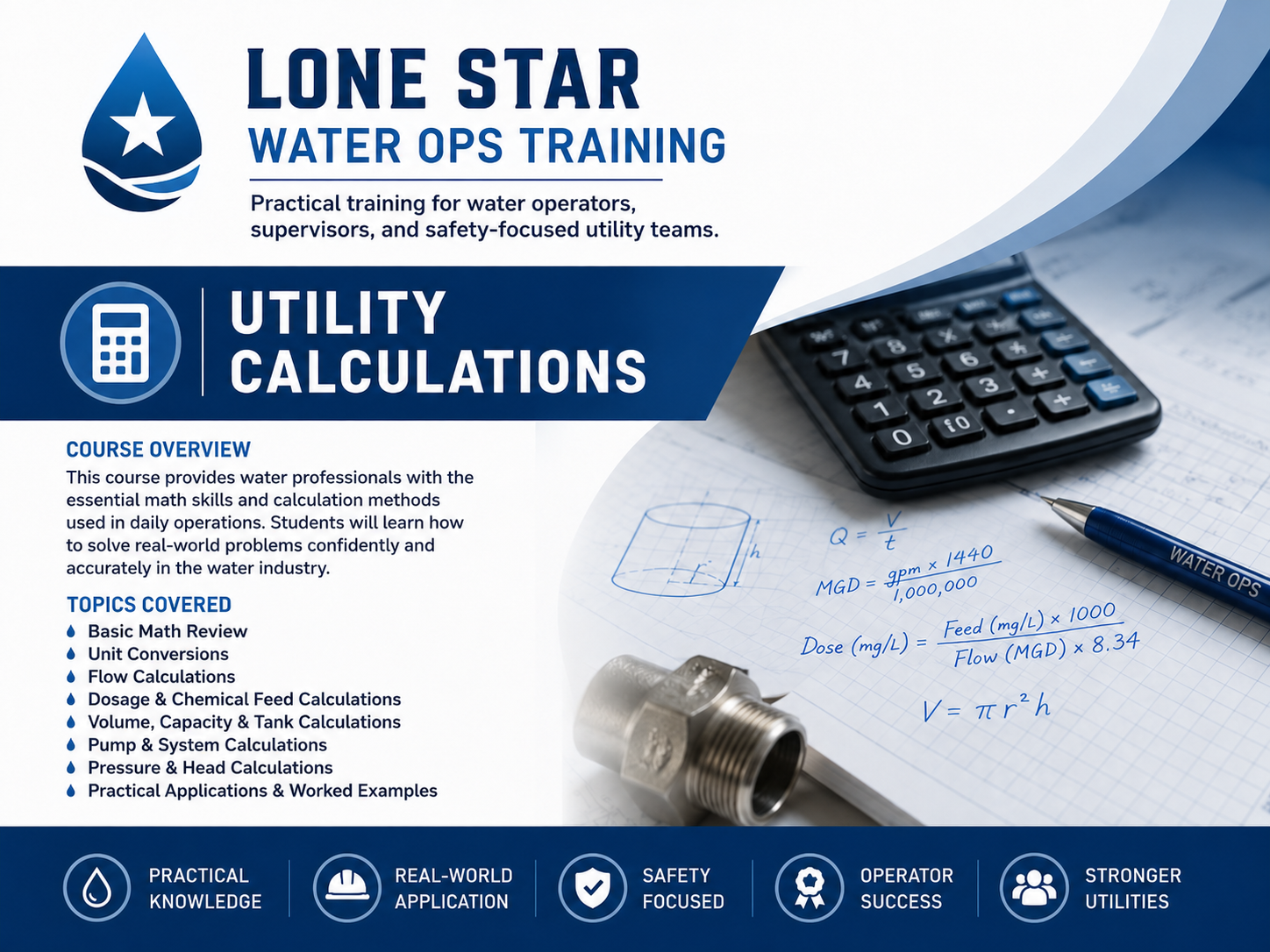
This course provides practical, operator-focused training on the math skills used in drinking water treatment and distribution. Students learn how to solve real-world problems involving flow, dosage, chemical feed, tank volume, detention time, pumping, pressure, unit conversions, and process control. This course helps water operators build confidence, improve accuracy, and prepare for TCEQ licensing requirements and daily field operations. 20-Hr Cours
Prerequisites
There are no prerequisites for this course.
Course Completion Requirements
Participants must provide information for all required fields, including their U.S. citizenship/permanent resident information, in addition to meeting all attendance and course completion requirements. If this information is not provided, the participant may be considered incomplete and may not receive a certificate of completion.
Participant Must Provide
Simple calculator with square root function.
Photo identification on the first day of class. See the “Policy” page of the website for approved forms of identification and additional guidelines.
Course materials, notebook, and writing utensils as directed by the instructor.
Access to any required course handouts, formula sheets, or calculation worksheets provided by the instructor.
Attendance Requirements
Class attendance is an essential part of the education process. Participants are expected to attend all class sessions, activities, discussions, and required exercises. This course requires participants to attend a minimum of 100% of the class hours as a component of successful course completion. During the course, the instructor will review any additional attendance, participation, or exercise requirements.
Recommended Prior Training Courses or Knowledge
Prior completion of Basic Water Operations or equivalent water utility experience is recommended but not required. Participants should have basic familiarity with drinking water treatment, distribution, pumping, storage, chemical feed, and common operator responsibilities. Basic math skills are helpful, but the course is designed to review and reinforce practical calculation methods step by step.
Upon Successful Completion, Participants Will Be Able To
Perform basic math operations commonly used in water utility work.
Convert units used in drinking water treatment, distribution, pumping, storage, and chemical-feed applications.
Calculate flow rates using gallons per minute, million gallons per day, and related operational units.
Calculate chemical dosage, feed rates, solution strength, and chemical application rates.
Determine tank volume, storage capacity, detention time, and related process-control values.
Solve pump, pressure, head, and system-related calculations used in daily water operations.
Apply formulas accurately using a simple calculator with square root function.
Evaluate real-world water utility problems using organized, step-by-step calculation methods.
Use calculation results to support safe, effective, and compliant water system operations.
This course introduces operators to common drinking water laboratory tests and proper sampling practices. Topics include pH, turbidity, chlorine residual, bacteriological sampling, sample preservation, calibration, quality control, record keeping, and interpreting lab results. The goal is to help operators make better process decisions using accurate data. 20-Hr Course
Prerequisites
There are no prerequisites for this course.
Course Completion Requirements
Participants must provide information for all required fields, including their U.S. citizenship/permanent resident status, and meet all attendance and course completion requirements. If this information is not provided, the participant may be considered incomplete and may not receive a certificate of completion.
Participant Must Provide
Simple calculator with square root function.
Photo identification on the first day of class. See the “Policy” page of the website for approved forms of identification and additional guidelines.
Course materials, notebook, and writing utensils as directed by the instructor.
Attendance Requirements
Class attendance is an essential part of the education process. Participants are expected to attend all class sessions, activities, discussions, and required exercises. This course requires participants to attend a minimum of 100% of the class hours as a component of successful course completion. During the course, the instructor will review any additional attendance or participation requirements.
Recommended Prior Training Courses or Knowledge
Prior completion of Basic Water Operations is recommended but not required. Participants should have a basic understanding of water quality, disinfection, sampling, and public water system operations.
Upon Successful Completion, Participants Will Be Able To
Describe common drinking water laboratory tests and their operational importance.
Explain proper sampling, sample handling, preservation, and documentation practices.
Identify basic laboratory equipment used for pH, turbidity, disinfectant residual, alkalinity, hardness, and other common water quality tests.
Recognize quality assurance, quality control, calibration, and recordkeeping requirements.
Apply laboratory results to support treatment decisions and regulatory compliance.
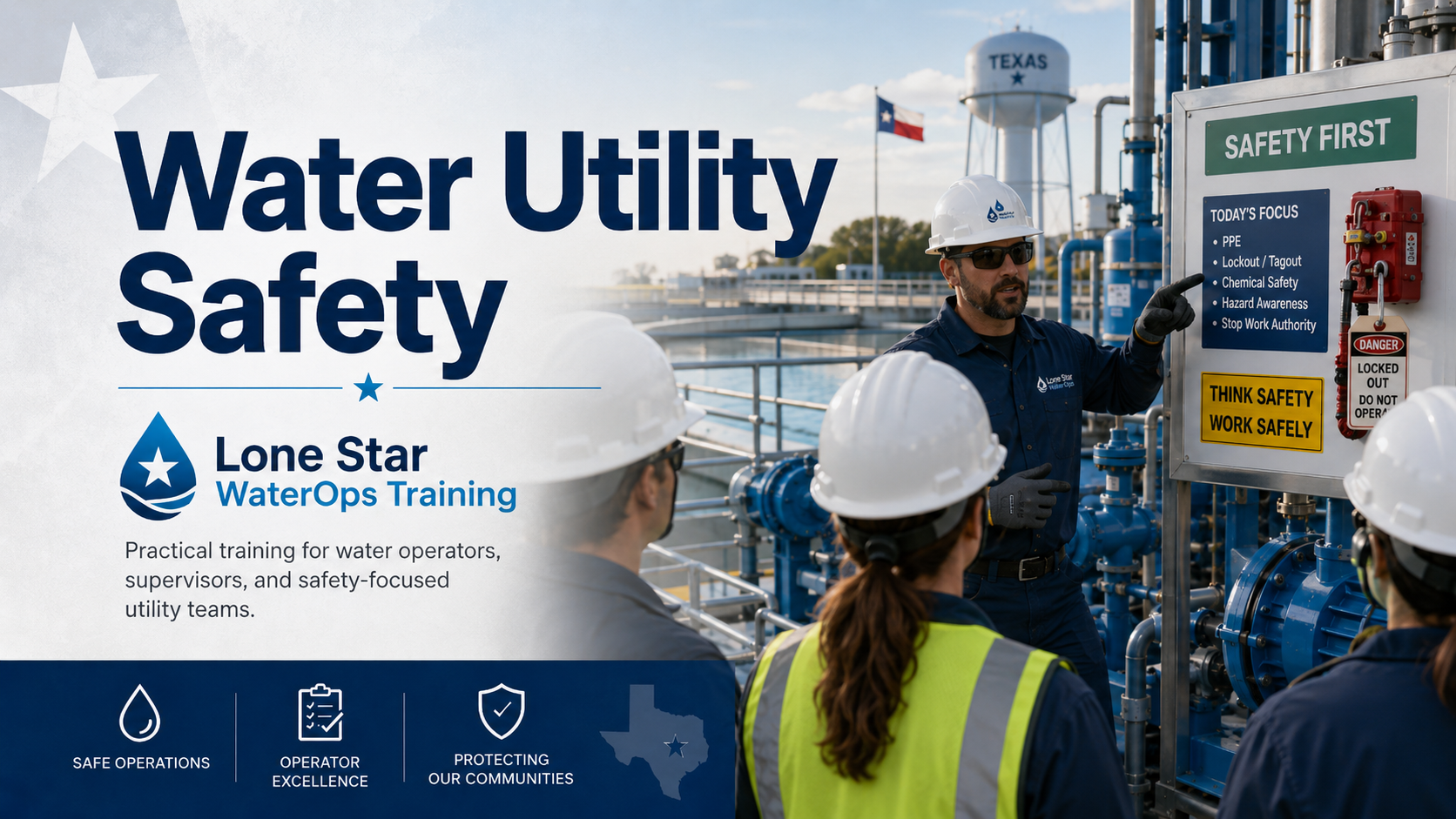
This course covers safety hazards commonly found in water utility work. Topics may include PPE, chemical safety, lockout/tagout, confined space awareness, hazard communication, slips/trips/falls, electrical hazards, excavation safety, emergency response, and safe work planning. The focus is simple: protect the operator, protect the crew, and protect the public. 20-Hr Course
Prerequisites
There are no prerequisites for this course.
Course Completion Requirements
Participants must provide information for all required fields, including their U.S. citizenship/permanent resident status, and meet all attendance and course completion requirements. If this information is not provided, the participant may be considered incomplete and may not receive a certificate of completion.
Participant Must Provide
Simple calculator with square root function, if directed by the instructor.
Photo identification on the first day of class. See the “Policy” page of the website for approved forms of identification and additional guidelines.
Course materials, notebook, and writing utensils as directed by the instructor.
Attendance Requirements
Class attendance is an essential part of the education process. Participants are expected to attend all class sessions, activities, discussions, and required exercises. This course requires participants to attend a minimum of 100% of the class hours as a component of successful course completion. During the course, the instructor will review any additional attendance or participation requirements.
Recommended Prior Training Courses or Knowledge
Prior water utility experience is recommended but not required. Participants should be familiar with basic utility work environments, plant operations, field work, PPE, and safe work expectations.
Upon Successful Completion, Participants Will Be Able To
Identify common safety hazards found in water treatment plants, pump stations, laboratories, and distribution systems.
Explain the importance of PPE, hazard communication, chemical safety, confined space awareness, lockout/tagout, and electrical safety.
Describe safe work practices for handling chemicals, tools, equipment, vehicles, and utility infrastructure.
Recognize emergency response, incident reporting, and stop-work responsibility concepts.
Apply safety principles that protect operators, coworkers, facilities, and the public.
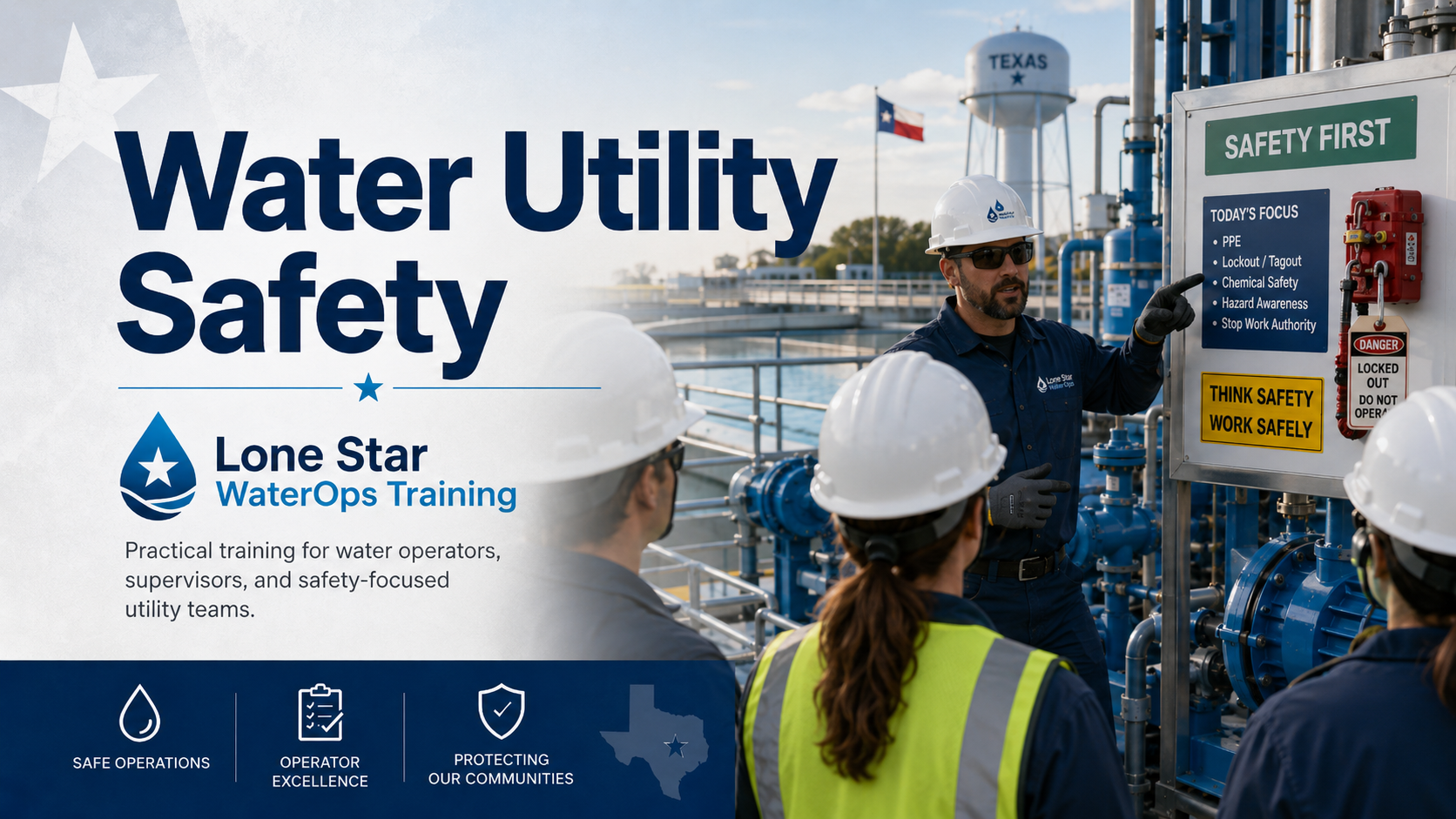
This course covers safety hazards commonly found in water utility work. Topics may include PPE, chemical safety, lockout/tagout, confined space awareness, hazard communication, slips/trips/falls, electrical hazards, excavation safety, emergency response, and safe work planning. The focus is simple: protect the operator, protect the crew, and protect the public. 20-Hr Course
Prerequisites
There are no prerequisites for this course.
Course Completion Requirements
Participants must provide information for all required fields, including their U.S. citizenship/permanent resident status, and meet all attendance and course completion requirements. If this information is not provided, the participant may be considered incomplete and may not receive a certificate of completion.
Participant Must Provide
Simple calculator with square root function, if directed by the instructor.
Photo identification on the first day of class. See the “Policy” page of the website for approved forms of identification and additional guidelines.
Course materials, notebook, and writing utensils as directed by the instructor.
Attendance Requirements
Class attendance is an essential part of the education process. Participants are expected to attend all class sessions, activities, discussions, and required exercises. This course requires participants to attend a minimum of 100% of the class hours as a component of successful course completion. During the course, the instructor will review any additional attendance or participation requirements.
Recommended Prior Training Courses or Knowledge
Prior water utility experience is recommended but not required. Participants should be familiar with basic utility work environments, plant operations, field work, PPE, and safe work expectations.
Upon Successful Completion, Participants Will Be Able To
Identify common safety hazards found in water treatment plants, pump stations, laboratories, and distribution systems.
Explain the importance of PPE, hazard communication, chemical safety, confined space awareness, lockout/tagout, and electrical safety.
Describe safe work practices for handling chemicals, tools, equipment, vehicles, and utility infrastructure.
Recognize emergency response, incident reporting, and stop-work responsibility concepts.
Apply safety principles that protect operators, coworkers, facilities, and the public.
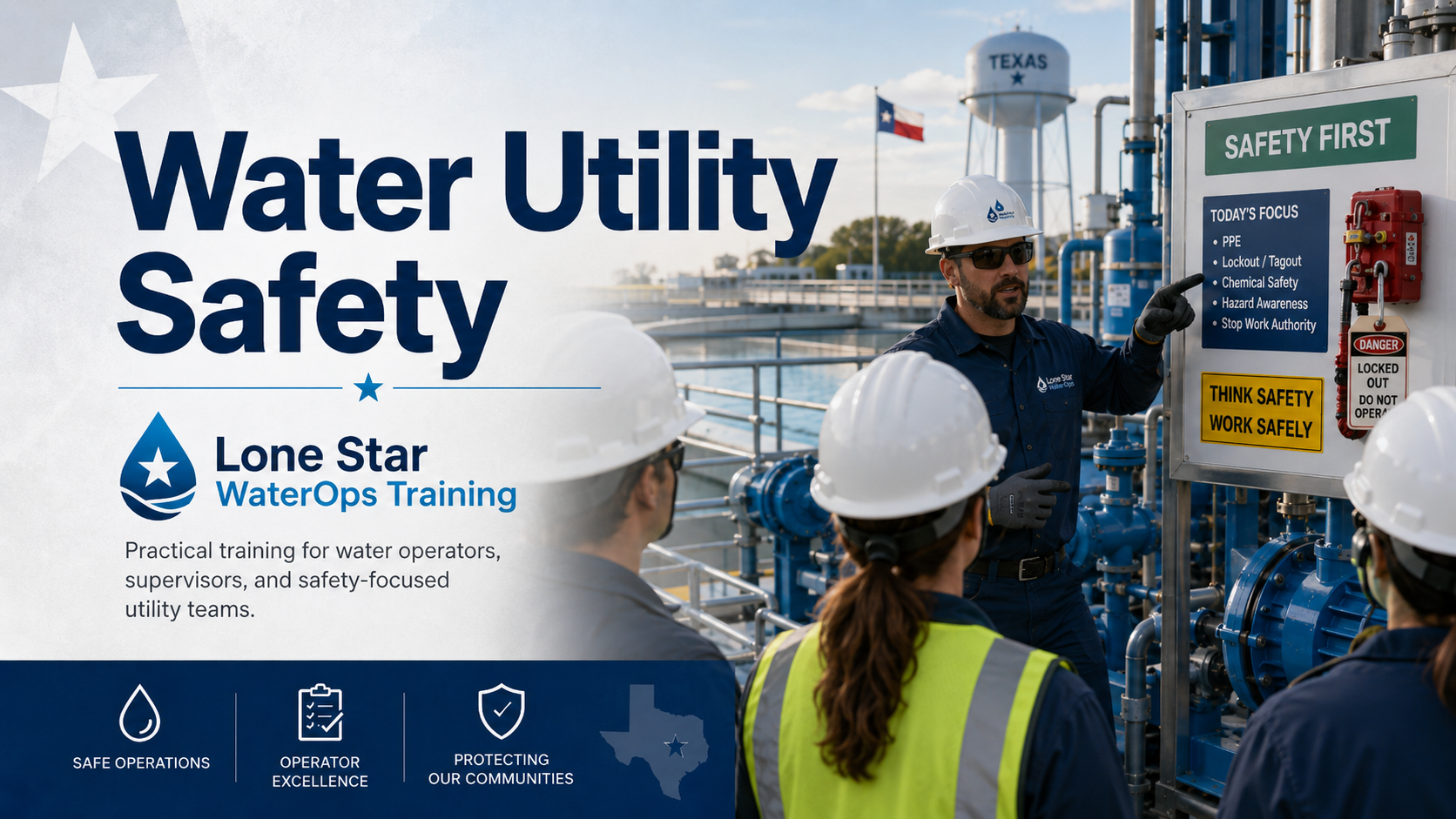
This course covers safety hazards commonly found in water utility work. Topics may include PPE, chemical safety, lockout/tagout, confined space awareness, hazard communication, slips/trips/falls, electrical hazards, excavation safety, emergency response, and safe work planning. The focus is simple: protect the operator, protect the crew, and protect the public. 20-Hr Course
Prerequisites
There are no prerequisites for this course.
Course Completion Requirements
Participants must provide information for all required fields, including their U.S. citizenship/permanent resident status, and meet all attendance and course completion requirements. If this information is not provided, the participant may be considered incomplete and may not receive a certificate of completion.
Participant Must Provide
Simple calculator with square root function, if directed by the instructor.
Photo identification on the first day of class. See the “Policy” page of the website for approved forms of identification and additional guidelines.
Course materials, notebook, and writing utensils as directed by the instructor.
Attendance Requirements
Class attendance is an essential part of the education process. Participants are expected to attend all class sessions, activities, discussions, and required exercises. This course requires participants to attend at least 100% of class hours as a condition for successful course completion. During the course, the instructor will review any additional attendance or participation requirements.
Recommended Prior Training Courses or Knowledge
Prior water utility experience is recommended but not required. Participants should be familiar with basic utility work environments, plant operations, field work, PPE, and safe work expectations.
Upon Successful Completion, Participants Will Be Able To
Identify common safety hazards found in water treatment plants, pump stations, laboratories, and distribution systems.
Explain the importance of PPE, hazard communication, chemical safety, confined space awareness, lockout/tagout, and electrical safety.
Describe safe work practices for handling chemicals, tools, equipment, vehicles, and utility infrastructure.
Recognize emergency response, incident reporting, and stop-work responsibility concepts.
Apply safety principles that protect operators, coworkers, facilities, and the public.
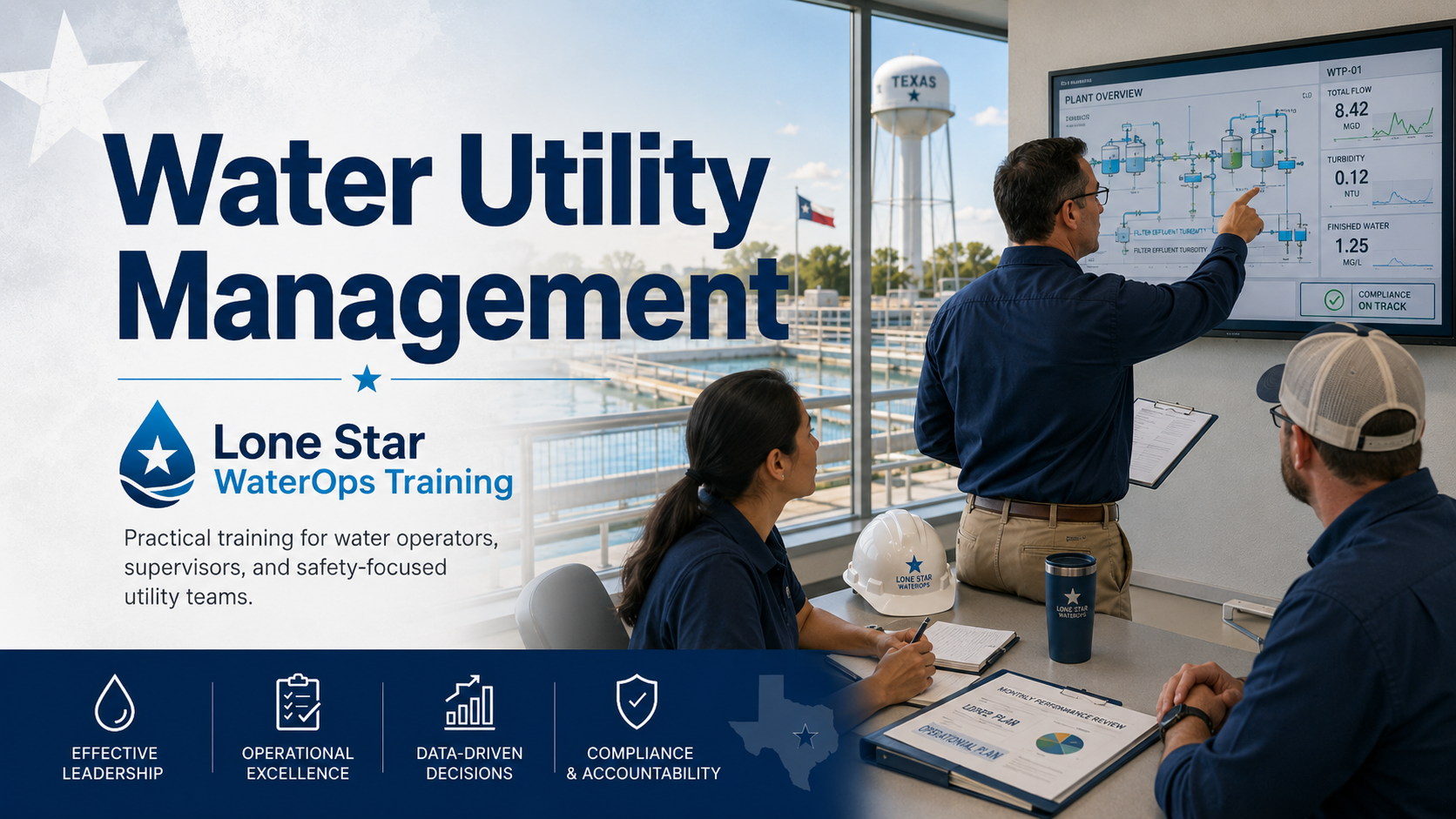
This course prepares operators and supervisors for leadership responsibilities in a public water system. Topics include regulations, staffing, budgeting, customer service, reporting, compliance planning, asset management, emergency planning, records, and supervision. It is especially useful for lead operators, supervisors, and operators preparing for higher-level licenses. 20-Hr Course
Prerequisites
There are no prerequisites for this course.
Course Completion Requirements
Participants must provide information for all required fields, including their U.S. citizenship/permanent resident status, and meet all attendance and course completion requirements. If this information is not provided, the participant may be considered incomplete and may not receive a certificate of completion.
Participant Must Provide
Simple calculator with square root function.
Photo identification on the first day of class. See the “Policy” page of the website for approved forms of identification and additional guidelines.
Course materials, notebook, and writing utensils as directed by the instructor.
Attendance Requirements
Class attendance is an essential part of the education process. Participants are expected to attend all class sessions, activities, discussions, and required exercises. This course requires participants to attend a minimum of 100% of the class hours as a component of successful course completion. During the course, the instructor will review any additional attendance or participation requirements.
Recommended Prior Training Courses or Knowledge
Prior water utility experience is recommended. This course is especially useful for lead operators, supervisors, chief operators, utility managers, and operators preparing for higher-level licensing or leadership roles.
Upon Successful Completion, Participants Will Be Able To
Explain key responsibilities of water utility leadership and management.
Describe operational planning, staffing, budgeting, recordkeeping, compliance, customer service, and asset management considerations.
Evaluate management issues related to safety, emergency response, communication, and personnel supervision.
Recognize the importance of regulatory compliance, documentation, training, and accountability.
Apply practical leadership and management concepts to support reliable water utility operations.
This course prepares operators and supervisors for leadership responsibilities in a public water system. Topics include regulations, staffing, budgeting, customer service, reporting, compliance planning, asset management, emergency planning, records, and supervision. It is especially useful for lead operators, supervisors, and operators preparing for higher-level licenses. 20-Hr Course
Prerequisites
There are no prerequisites for this course.
Course Completion Requirements
Participants must provide information for all required fields, including their U.S. citizenship/permanent resident status, and meet all attendance and course completion requirements. If this information is not provided, the participant may be considered incomplete and may not receive a certificate of completion.
Participant Must Provide
Simple calculator with square root function.
Photo identification on the first day of class. See the “Policy” page of the website for approved forms of identification and additional guidelines.
Course materials, notebook, and writing utensils as directed by the instructor.
Attendance Requirements
Class attendance is an essential part of the education process. Participants are expected to attend all class sessions, activities, discussions, and required exercises. This course requires participants to attend a minimum of 100% of the class hours as a component of successful course completion. During the course, the instructor will review any additional attendance or participation requirements.
Recommended Prior Training Courses or Knowledge
Prior water utility experience is recommended. This course is especially useful for lead operators, supervisors, chief operators, utility managers, and operators preparing for higher-level licensing or leadership roles.
Upon Successful Completion, Participants Will Be Able To
Explain key responsibilities of water utility leadership and management.
Describe operational planning, staffing, budgeting, recordkeeping, compliance, customer service, and asset management considerations.
Evaluate management issues related to safety, emergency response, communication, and personnel supervision.
Recognize the importance of regulatory compliance, documentation, training, and accountability.
Apply practical leadership and management concepts to support reliable water utility operations.
This course prepares operators and supervisors for leadership responsibilities in a public water system. Topics include regulations, staffing, budgeting, customer service, reporting, compliance planning, asset management, emergency planning, records, and supervision. It is especially useful for lead operators, supervisors, and operators preparing for higher-level licenses. 20-Hr Course
Prerequisites
There are no prerequisites for this course.
Course Completion Requirements
Participants must provide information for all required fields, including their U.S. citizenship/permanent resident status, and meet all attendance and course completion requirements. If this information is not provided, the participant may be considered incomplete and may not receive a certificate of completion.
Participant Must Provide
Simple calculator with square root function.
Photo identification on the first day of class. See the “Policy” page of the website for approved forms of identification and additional guidelines.
Course materials, notebook, and writing utensils as directed by the instructor.
Attendance Requirements
Class attendance is an essential part of the education process. Participants are expected to attend all class sessions, activities, discussions, and required exercises. This course requires participants to attend at least 100% of class hours as a condition for successful course completion. During the course, the instructor will review any additional attendance or participation requirements.
Recommended Prior Training Courses or Knowledge
Prior water utility experience is recommended. This course is especially useful for lead operators, supervisors, chief operators, utility managers, and operators preparing for higher-level licensing or leadership roles.
Upon Successful Completion, Participants Will Be Able To
Explain key responsibilities of water utility leadership and management.
Describe operational planning, staffing, budgeting, recordkeeping, compliance, customer service, and asset management considerations.
Evaluate management issues related to safety, emergency response, communication, and personnel supervision.
Recognize the importance of regulatory compliance, documentation, training, and accountability.
Apply practical leadership and management concepts to support reliable water utility operations.
This course provides practical, operator-focused training on the math skills used in drinking water treatment and distribution. Students learn how to solve real-world problems involving flow, dosage, chemical feed, tank volume, detention time, pumping, pressure, unit conversions, and process control. This course helps water operators build confidence, improve accuracy, and prepare for TCEQ licensing requirements and daily field operations. 20-Hr Course
Prerequisites
There are no prerequisites for this course.
Course Completion Requirements
Participants must provide information for all required fields, including their U.S. citizenship/permanent resident status, and meet all attendance and course completion requirements. If this information is not provided, the participant may be considered incomplete and may not receive a certificate of completion.
Participant Must Provide
Simple calculator with square root function.
Photo identification on the first day of class. See the “Policy” page of the website for approved forms of identification and additional guidelines.
Course materials, notebook, and writing utensils as directed by the instructor.
Access to any required course handouts, formula sheets, or calculation worksheets provided by the instructor.
Attendance Requirements
Class attendance is an essential part of the education process. Participants are expected to attend all class sessions, activities, discussions, and required exercises. This course requires participants to attend at least 100% of class hours as a condition for successful course completion. During the course, the instructor will review any additional attendance, participation, or exercise requirements.
Recommended Prior Training Courses or Knowledge
Prior completion of Basic Water Operations or equivalent water utility experience is recommended but not required. Participants should have basic familiarity with drinking water treatment, distribution, pumping, storage, chemical feed, and common operator responsibilities. Basic math skills are helpful, but the course is designed to review and reinforce practical calculation methods step by step.
Upon Successful Completion, Participants Will Be Able To
Perform basic math operations commonly used in water utility work.
Convert units used in drinking water treatment, distribution, pumping, storage, and chemical-feed applications.
Calculate flow rates using gallons per minute, million gallons per day, and related operational units.
Calculate chemical dosage, feed rates, solution strength, and chemical application rates.
Determine tank volume, storage capacity, detention time, and related process-control values.
Solve pump, pressure, head, and system-related calculations used in daily water operations.
Apply formulas accurately using a simple calculator with a square root function.
Evaluate real-world water utility problems using organized, step-by-step calculation methods.
Use calculation results to support safe, effective, and compliant water system operations.
This course provides practical, operator-focused training on the math skills used in drinking water treatment and distribution. Students learn how to solve real-world problems involving flow, dosage, chemical feed, tank volume, detention time, pumping, pressure, unit conversions, and process control. This course helps water operators build confidence, improve accuracy, and prepare for TCEQ licensing requirements and daily field operations. 20-Hr Cours
Prerequisites
There are no prerequisites for this course.
Course Completion Requirements
Participants must provide information for all required fields, including their U.S. citizenship/permanent resident information, in addition to meeting all attendance and course completion requirements. If this information is not provided, the participant may be considered incomplete and may not receive a certificate of completion.
Participant Must Provide
Simple calculator with square root function.
Photo identification on the first day of class. See the “Policy” page of the website for approved forms of identification and additional guidelines.
Course materials, notebook, and writing utensils as directed by the instructor.
Access to any required course handouts, formula sheets, or calculation worksheets provided by the instructor.
Attendance Requirements
Class attendance is an essential part of the education process. Participants are expected to attend all class sessions, activities, discussions, and required exercises. This course requires participants to attend a minimum of 100% of the class hours as a component of successful course completion. During the course, the instructor will review any additional attendance, participation, or exercise requirements.
Recommended Prior Training Courses or Knowledge
Prior completion of Basic Water Operations or equivalent water utility experience is recommended but not required. Participants should have basic familiarity with drinking water treatment, distribution, pumping, storage, chemical feed, and common operator responsibilities. Basic math skills are helpful, but the course is designed to review and reinforce practical calculation methods step by step.
Upon Successful Completion, Participants Will Be Able To
Perform basic math operations commonly used in water utility work.
Convert units used in drinking water treatment, distribution, pumping, storage, and chemical-feed applications.
Calculate flow rates using gallons per minute, million gallons per day, and related operational units.
Calculate chemical dosage, feed rates, solution strength, and chemical application rates.
Determine tank volume, storage capacity, detention time, and related process-control values.
Solve pump, pressure, head, and system-related calculations used in daily water operations.
Apply formulas accurately using a simple calculator with square root function.
Evaluate real-world water utility problems using organized, step-by-step calculation methods.
Use calculation results to support safe, effective, and compliant water system operations.
This course provides practical, operator-focused training on the math skills used in drinking water treatment and distribution. Students learn how to solve real-world problems involving flow, dosage, chemical feed, tank volume, detention time, pumping, pressure, unit conversions, and process control. This course helps water operators build confidence, improve accuracy, and prepare for TCEQ licensing requirements and daily field operations. 20-Hr Course
Prerequisites
There are no prerequisites for this course.
Course Completion Requirements
Participants must provide information for all required fields, including their U.S. citizenship/permanent resident status, and meet all attendance and course completion requirements. If this information is not provided, the participant may be considered incomplete and may not receive a certificate of completion.
Participant Must Provide
Simple calculator with square root function.
Photo identification on the first day of class. See the “Policy” page of the website for approved forms of identification and additional guidelines.
Course materials, notebook, and writing utensils as directed by the instructor.
Access to any required course handouts, formula sheets, or calculation worksheets provided by the instructor.
Attendance Requirements
Class attendance is an essential part of the education process. Participants are expected to attend all class sessions, activities, discussions, and required exercises. This course requires participants to attend a minimum of 100% of the class hours as a component of successful course completion. During the course, the instructor will review any additional attendance, participation, or exercise requirements.
Recommended Prior Training Courses or Knowledge
Prior completion of Basic Water Operations or equivalent water utility experience is recommended but not required. Participants should have basic familiarity with drinking water treatment, distribution, pumping, storage, chemical feed, and common operator responsibilities. Basic math skills are helpful, but the course is designed to review and reinforce practical calculation methods step by step.
Upon Successful Completion, Participants Will Be Able To
Perform basic math operations commonly used in water utility work.
Convert units used in drinking water treatment, distribution, pumping, storage, and chemical-feed applications.
Calculate flow rates using gallons per minute, million gallons per day, and related operational units.
Calculate chemical dosage, feed rates, solution strength, and chemical application rates.
Determine tank volume, storage capacity, detention time, and related process-control values.
Solve pump, pressure, head, and system-related calculations used in daily water operations.
Apply formulas accurately using a simple calculator with a square root function.
Evaluate real-world water utility problems using organized, step-by-step calculation methods.
Use calculation results to support safe, effective, and compliant water system operations.
No results found
No results match your search. Try removing a few filters.